

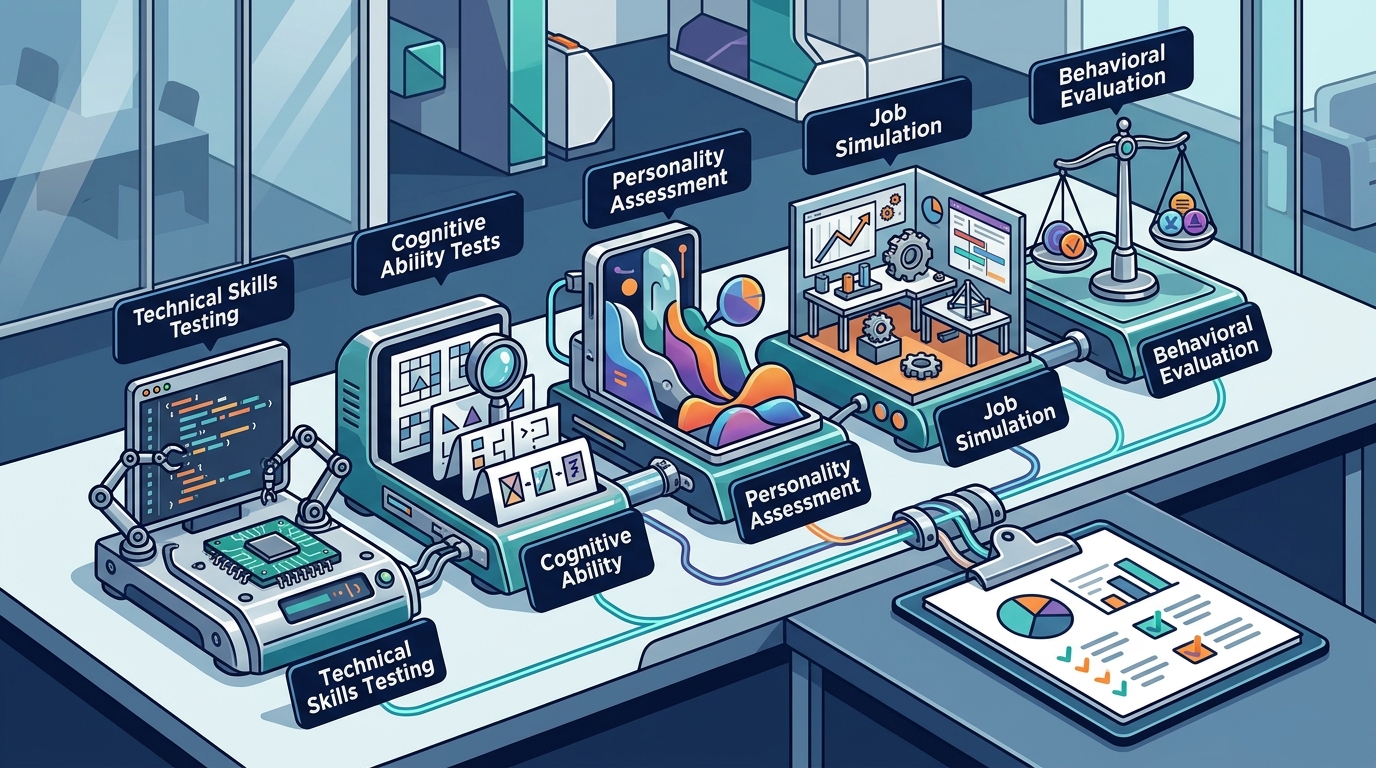
Recruiting firms use pre-employment assessment tools to verify candidate skills, cognitive ability, and behavioral fit before scheduling interviews. These tools reduce time-to-hire and improve candidate quality. This guide covers the five core tool categories: technical skills testing, cognitive ability tests, personality assessments, job simulations, and behavioral evaluations. For additional details, review the Vaultio Hiring Infrastructure for.
Technical Skills Testing
Technical skills testing is the process of evaluating a candidate's ability to perform specific job-related tasks using practical exercises. For engineering and product roles, this is the most critical layer of screening. Traditional static test banks are failing because questions leak into online communities and answer-key marketplaces. When questions leak, recruiters rank candidates on their ability to find answers, not their ability to solve problems.
Dynamic Generation vs. Static Banks
Modern platforms like Vaultio address this by generating unique assessments for every candidate. Instead of pulling from a static bank, the system creates a new test based on the specific job description and the candidate's CV claims. This means two applicants for the same role receive different questions. The test does not exist until the candidate opens it, eliminating the possibility of pre-leaking.
Server-Side Grading and Integrity
Integrity in technical testing relies on server-side grading. The candidate's browser never sees the correct answers or hidden test cases. When a candidate submits code, it runs against an authoritative test runner on the server. This architecture ensures that even if a candidate inspects the page source, there is nothing to tamper with. Integrity signals, such as tab-switching or copy-paste events, are recorded as flags for the recruiter to review, rather than automatically disqualifying the candidate.
Cognitive Ability Tests
Cognitive ability tests are standardized evaluations designed to measure a candidate's reasoning, problem-solving, and learning capacity. These tests are role-agnostic, meaning they measure general mental aptitude rather than specific technical knowledge. They are particularly useful for early-career candidates or roles where on-the-job training is significant.
Types of Cognitive Assessments
Integration with Technical Testing
Recruiting firms often use cognitive tests as a first-pass filter before technical skills testing. This approach saves time by removing candidates who struggle with basic logical reasoning before they are subjected to complex coding challenges. However, cognitive scores should not be the sole determinant of hiring. They are best used in conjunction with role-specific technical assessments to provide a holistic view of a candidate's potential.
Personality Assessments
Personality assessments are psychometric tools that measure a candidate's behavioral tendencies, work style, and cultural fit. These tests do not have right or wrong answers. Instead, they provide a profile of how a candidate is likely to behave in a team environment. Common frameworks include the Big Five (OCEAN) and the Myers-Briggs Type Indicator (MBTI), though the latter is less commonly used in rigorous hiring contexts due to lower test-retest reliability.
Team Dynamics and Cultural Add
For recruiting firms, personality assessments help predict how a candidate will interact with existing team members. A highly technical engineer who is also highly introverted and detail-oriented may be a perfect fit for a backend role but a poor fit for a client-facing product management position. By understanding a candidate's personality profile, recruiters can match them to roles where their natural tendencies are assets rather than liabilities. This focus on "cultural add" rather than just "cultural fit" helps build diverse and complementary teams.
Limitations and Bias
It is important to note that personality assessments are decision-support information, not definitive predictors of performance. They should not be used to reject candidates based on subjective preferences. Recruiters must be trained to interpret these profiles objectively and avoid bias. The goal is to understand working styles, not to stereotype individuals.
Job Simulations
Scenario-Based Testing
High-quality job simulations use scenario-based testing. For example, a software engineering simulation might present a candidate with a broken codebase and a set of requirements. The candidate must debug the code, implement the new features, and write unit tests. This tests not just coding ability, but also problem-solving, attention to detail, and code quality. The output is a tangible artifact that the hiring team can review.
Weighted Rubrics
Grading job simulations requires weighted rubrics. Different aspects of the task are assigned different importance levels. For a coding simulation, correctness might be weighted 50%, code quality 30%, and efficiency 20%. This ensures that the final score reflects the most critical competencies for the role. AI-assisted grading can help standardize this process, but human review is still essential for final decisions.
Behavioral Evaluations
Behavioral evaluations are structured interviews or written responses that ask candidates to describe past experiences and how they handled specific situations. These evaluations are based on the premise that past behavior is the best predictor of future behavior. They focus on competencies such as leadership, conflict resolution, and adaptability.
Structured vs. Unstructured
Structured behavioral evaluations use a standardized set of questions for all candidates applying for the same role. This ensures fairness and comparability. Unstructured interviews, where questions vary by candidate, are more prone to bias and inconsistency. Recruiting firms should prioritize structured behavioral evaluations to ensure that all candidates are assessed on the same criteria.
Competency Mapping
Comparison of Assessment Tools
| Tool Type | Primary Purpose | Best For | Limitations |
|---|---|---|---|
| Technical Skills Testing | Verify specific job-related skills | Engineering, Product, Data roles | Requires role-specific question generation |
| Cognitive Ability Tests | Measure general reasoning and learning capacity | Early-career candidates, generalist roles | Does not measure specific job skills |
| Personality Assessments | Profile behavioral tendencies and work style | Team fit, cultural add | Not a predictor of technical performance |
| Job Simulations | Evaluate ability to perform real-world tasks | Senior roles, complex problem-solving | Time-consuming to grade |
| Behavioral Evaluations | Assess past behavior and competencies | Leadership, soft skills, cultural fit | Subject to self-reporting bias |
Key Takeaways
- Technical skills testing is the most critical layer for verifying candidate ability in technical roles.
- Static test banks are vulnerable to question leakage; dynamic generation prevents this.
- Cognitive ability tests measure general aptitude and are useful for early-career screening.
- Personality assessments help predict team dynamics and cultural add, not technical performance.
- Job simulations provide the closest proxy to on-the-job performance by requiring real work products.
- Behavioral evaluations should be structured and mapped to specific competencies to ensure fairness.
- Assessment tools are decision-support information, not definitive predictors of performance.
- Recruiters should use a combination of tools to get a holistic view of each candidate.
Frequently Asked Questions
What is the most important pre-employment assessment tool for technical roles?
Technical skills testing is the most important tool for technical roles. It directly verifies a candidate's ability to perform the specific tasks required for the job. While cognitive and personality tests provide useful context, they do not replace the need for practical skills verification.
How do dynamic assessments prevent cheating?
Dynamic assessments prevent cheating by generating unique questions for each candidate. Since the test does not exist until the candidate opens it, there is nothing to leak in advance. Additionally, server-side grading ensures that the correct answers are never exposed to the candidate's browser.
Can personality assessments be used to reject candidates?
Personality assessments should not be used as the sole basis for rejecting candidates. They are decision-support information that helps recruiters understand a candidate's work style and potential team fit. Hiring decisions should be based on a combination of skills, experience, and behavioral evidence.
What is the difference between a job simulation and a technical test?
A technical test typically uses multiple-choice questions or short coding problems to verify specific knowledge. A job simulation requires the candidate to complete a realistic, multi-step task that mimics real-world work. Job simulations provide a more comprehensive view of a candidate's ability to perform the role.
How long should a pre-employment assessment take?
The length of an assessment depends on the role and the tools used. Technical skills tests typically take 30 to 60 minutes. Job simulations can take 1 to 3 hours. Cognitive and personality tests usually take 20 to 30 minutes. The total assessment time should be reasonable and clearly communicated to the candidate.
Do assessment tools replace interviews?
No, assessment tools do not replace interviews. They are designed to complement interviews by providing objective data on a candidate's skills and behavior. Interviews allow recruiters to explore a candidate's experience, motivation, and communication style in more depth. The two should be used together for a complete evaluation.
How can recruiting firms ensure fairness in assessments?
Recruiting firms can ensure fairness by using structured, standardized assessments for all candidates applying for the same role. They should also monitor assessment outcomes for disparate impact and adjust tools or criteria if necessary. Transparency with candidates about what is being assessed and why is also important.
What is the role of AI in pre-employment assessments?
AI is used in pre-employment assessments to generate unique questions, grade responses, and analyze data. AI can help standardize grading and reduce human bias. However, AI is a tool, not a decision-maker. Final hiring decisions should always be made by humans who can consider the full context of a candidate's application.
Conclusion
Pre-employment assessment tools are essential for recruiting firms looking to improve hiring quality and efficiency. By combining technical skills testing, cognitive ability tests, personality assessments, job simulations, and behavioral evaluations, recruiters can build a comprehensive view of each candidate. Vaultio provides the infrastructure to generate and grade these assessments, giving recruiters the evidence they need to make confident hiring decisions. To explore how assessment-first hiring works, visit the Vaultio for Companies page.