

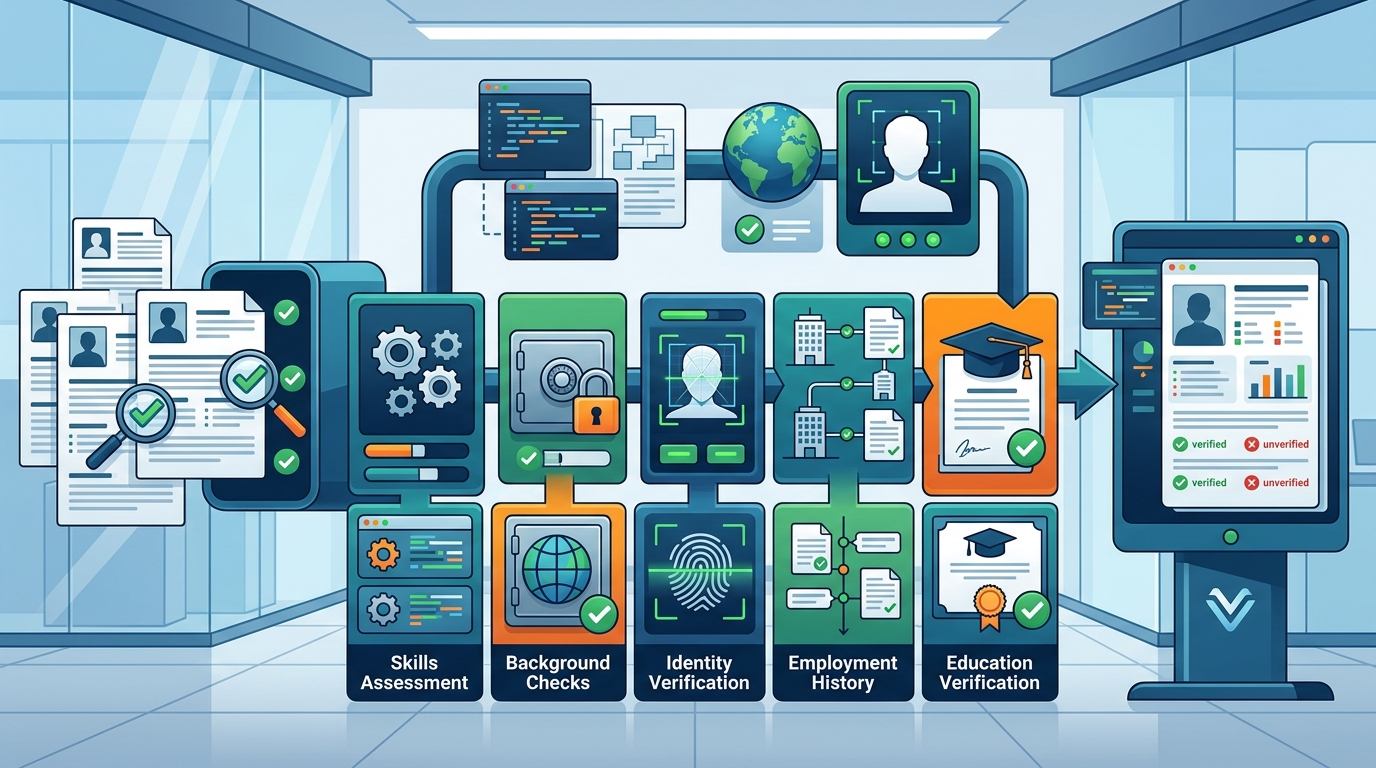
CV verification tools are software systems that validate the factual accuracy of a candidate's resume before interview stages. In 2026, the most effective approach combines skills assessment, background checks, and identity verification to filter out inflated claims. This guide covers five categories of verification tools, explaining how each works and where it fits in a modern hiring workflow. For additional details, review the Verify Talent Skills Before.
Background Screening Platforms
Background screening is the process of verifying a candidate's employment history, education, and criminal record. These platforms connect to third-party data providers to confirm that the dates, titles, and degrees listed on a CV are accurate. For roles with high security or compliance requirements, this is the first line of defense against fabricated credentials.
Employment and Education Verification
Most background check services focus on confirming previous employers and academic institutions. They verify start and end dates, job titles, and degree completion. This helps identify candidates who have inflated their tenure or claimed degrees they did not earn. While these checks are factual, they do not assess whether the candidate actually possessed the skills they claim to have.
Limitations of Background Checks
Background screening confirms what happened, not how well it was done. A candidate can have a verified employment history but still lack the technical proficiency required for the role. Therefore, background checks should be used in conjunction with skills assessments to provide a complete picture of candidate truthfulness.
Skills Assessment Tools
Skills assessment is the evaluation of a candidate's practical abilities through practical tasks, coding challenges, or scenario-based questions. Unlike background checks, which verify history, skills assessments verify current capability. In 2026, AI-generated CVs have made this category critical, as resumes can be easily tailored to match job description keywords without reflecting actual ability.
The Problem with Static Test Banks
Traditional assessment platforms often use static question banks. These questions can be leaked on forums or shared among candidates, allowing applicants to memorize answers rather than demonstrate skill. This undermines the integrity of the assessment. Modern platforms address this by generating unique assessments for each candidate based on their specific CV claims and the role requirements.
CV-Aware Assessment Generation
Advanced assessment tools analyze the specific skills a candidate claims on their CV. If a resume states "5 years of React experience," the assessment engine generates React-specific problems. This ensures the test is relevant to the candidate's declared expertise. Vaultio uses this approach to create unique tests that verify whether the claimed skills hold up under pressure. This method reduces the effectiveness of AI-optimized resumes because the test is tailored to the specific claims made.
Reference Checking Services
Reference checking is the practice of contacting previous supervisors or colleagues to verify a candidate's work performance and behavior. While traditional phone calls are still common, automated reference checking services use structured questionnaires to gather consistent feedback. These services help verify soft skills and cultural fit, which are rarely captured in CVs or technical tests.
Structured vs. Unstructured References
Unstructured phone calls can be biased and inconsistent. Structured reference checking uses standardized questions to ensure all candidates are evaluated on the same criteria. This provides a more reliable signal about a candidate's reliability and teamwork. However, references are subjective and may not reflect technical accuracy. They are best used as a final validation step after skills and background checks are complete.
Identity Verification
Identity verification is the process of confirming that the person applying for the job is the same person who completed the assessments and background checks. This is crucial for remote hiring, where candidates may be located in different jurisdictions. Identity verification tools use government-issued IDs, biometric matching, and liveness detection to prevent identity fraud.
Preventing Impersonation in Remote Hiring
In remote work environments, identity fraud is a growing risk. A candidate might use a friend's identity to pass a background check or assessment. Identity verification ensures that the individual who passed the tests is the one who will be hired. This adds a layer of security that is essential for companies hiring globally. It complements skills assessments by ensuring the person being evaluated is the person being hired.
Professional License Verification
Professional license verification is the confirmation that a candidate holds valid, active licenses required for their role. This is particularly important for regulated industries such as healthcare, finance, and engineering. These tools connect to state or national licensing boards to verify that a license is current and in good standing.
Importance in Regulated Industries
For roles requiring specific certifications, such as CPA, PMP, or medical licenses, verification is non-negotiable. A CV may list a license that has expired or been revoked. Automated verification tools check the status in real-time, ensuring compliance with industry regulations. This is a factual check that does not assess skill but confirms legal eligibility to perform the job.
Comparison of Verification Methods
| Verification Type | What It Verifies | Primary Use Case | Limitations |
|---|---|---|---|
| Background Screening | Employment history, education, criminal record | Compliance, security clearance | Does not assess current skills |
| Skills Assessment | Practical ability, technical proficiency | Technical roles, engineering, product | May not reflect soft skills or culture fit |
| Reference Checking | Work behavior, reliability, soft skills | Leadership roles, team-based positions | Subjective, can be biased |
| Identity Verification | Legal identity, biometric match | Remote hiring, global teams | Does not assess skill or history |
| License Verification | Professional certification status | Regulated industries, healthcare, finance | Only applies to licensed professions |
Key Takeaways
- No single tool verifies all aspects of a CV; a combination of methods is required for comprehensive screening.
- Skills assessments are the most effective tool for verifying technical claims, especially when generated uniquely per candidate.
- Background checks confirm history but do not prove current ability; they should be paired with practical tests.
- Identity verification is critical for remote hiring to prevent impersonation and fraud.
- Reference checking provides subjective insights into behavior and reliability, complementing objective tests.
- License verification is essential for regulated industries to ensure legal compliance.
- AI-generated CVs have increased the need for dynamic, CV-aware assessments to detect inflated claims.
- Integrity signals in assessments are flags for review, not automatic disqualifications; human judgment remains essential.
Frequently Asked Questions
Can AI-generated CVs be detected by standard ATS filters?
Standard Applicant Tracking Systems (ATS) often rank AI-generated CVs highly because they are optimized for keywords. This makes keyword-based screening less effective. Dynamic skills assessments are more reliable because they test actual ability rather than resume keywords.
Do skills assessments replace interviews?
No, skills assessments do not replace interviews. They provide objective data on technical ability, which helps recruiters focus interview time on culture fit and soft skills. Interviews remain a critical part of the hiring process for evaluating communication and teamwork.
How does CV-aware assessment generation work?
CV-aware assessment generation analyzes the specific skills and experience claimed on a candidate's resume. The assessment engine then creates unique questions tailored to those claims. This ensures the test is relevant and difficult enough to verify the claimed expertise.
Is identity verification required for all remote hires?
While not legally required in all jurisdictions, identity verification is a best practice for remote hiring. It helps prevent fraud and ensures that the person being hired is the one who passed the assessments. Companies should assess their risk tolerance and compliance requirements.
Can background checks detect skill inflation?
Background checks verify that a candidate worked at a company or earned a degree, but they do not verify the level of skill or performance. A candidate can have a verified employment history but still lack the technical skills required for the role. Skills assessments are needed to detect skill inflation.
How often should professional licenses be verified?
Professional licenses should be verified at the time of hiring and periodically thereafter, depending on the industry and regulatory requirements. Some licenses require annual renewal, so continuous monitoring may be necessary for compliance.
Do assessment tools prevent cheating completely?
No assessment tool can prevent cheating completely. Integrity signals, such as tab-switching detection or time limits, are flags that indicate potential issues. These signals should be reviewed by human recruiters, who can make the final judgment based on the context.
What is the role of human judgment in CV verification?
Human judgment is essential in interpreting verification results. Tools provide data and flags, but recruiters must evaluate the overall fit, context, and potential of the candidate. No software can replace the nuanced decision-making required for hiring.
Conclusion
Verifying CV claims in 2026 requires a multi-layered approach. No single tool can confirm the truth of a resume. Companies should combine background screening, skills assessment, reference checking, identity verification, and license verification to build a comprehensive picture of a candidate. Vaultio offers a platform that integrates CV-aware skills assessments with other hiring tools, helping teams verify ability before spending time on interviews. By using the right combination of verification tools, hiring teams can reduce the risk of hiring candidates whose claims do not match their capabilities.