

Recruiting firms use pre-employment assessment tools to screen candidates efficiently before investing in interviews. These tools evaluate skills, cognitive ability, personality, and technical proficiency. Vaultio helps firms generate role-specific assessments from job requirements and candidate CVs. This guide covers the six primary tool categories used in modern hiring workflows.
Skills Testing
Skills testing is the process of evaluating a candidate's proficiency in specific job-related competencies. These tests verify that a candidate can perform the core tasks of the role. Recruiting firms use skills tests to filter out applicants who lack fundamental requirements. For additional details, review the .
Types of Skills Tests
Implementation in Recruiting
Recruiting firms often deploy skills tests as a first-pass screen. This reduces the volume of candidates who proceed to interviews. Vaultio generates these tests directly from job descriptions, ensuring alignment with actual role requirements.
Cognitive Ability Tests
Cognitive ability tests are assessments that measure a candidate's reasoning, problem-solving, and information processing capabilities. These tests predict how quickly a candidate can learn new concepts and adapt to complex problems. They are widely used for roles requiring high analytical thinking.
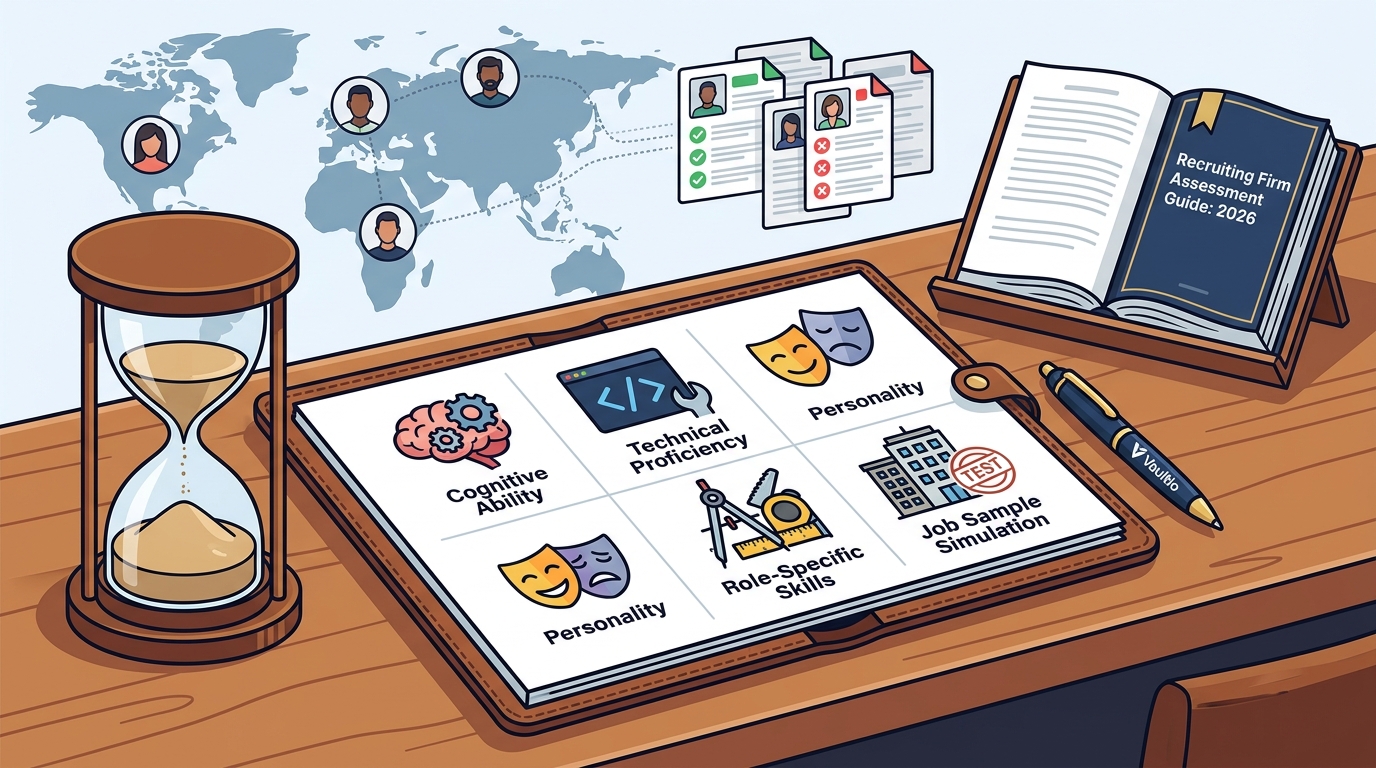
Components of Cognitive Tests
Relevance to Remote Roles
For remote positions, cognitive ability is a strong indicator of self-management and learning agility. Candidates who score well on cognitive tests often require less hand-holding in distributed teams. Firms use these scores to prioritize candidates for technical deep-dives.
Personality Assessments
Personality assessments are psychometric tools that evaluate a candidate's behavioral tendencies, work style, and cultural fit. These tools do not measure intelligence or skills. Instead, they provide insight into how a candidate is likely to interact with teams and handle stress.
Common Frameworks
Using Personality Data
Technical Coding Assessments
Technical coding assessments are practical evaluations that require candidates to write code, debug existing code, or solve algorithmic problems. These tests verify that a candidate's technical claims are accurate and practical. They are essential for engineering and product roles.
Assessment Formats
Coding assessments come in several formats, including take-home projects, live coding sessions, and automated coding challenges. Take-home projects allow candidates to work at their own pace. Live coding sessions simulate pair programming or whiteboard interviews. Automated challenges provide immediate feedback on code correctness and efficiency.
CV Claim Verification
A critical challenge in technical hiring is verifying CV claims. Candidates often list technologies they have only touched briefly. Vaultio addresses this by generating assessments based on the specific technologies and claims in a candidate's CV. This ensures the test targets what the candidate actually demonstrated in their career history.
Job Simulations
Job simulations are assessments that replicate real work tasks and scenarios from the target role. These tools provide the most direct evidence of a candidate's ability to perform the job. They bridge the gap between theoretical knowledge and practical application.
Designing Effective Simulations
Effective job simulations use realistic data, tools, and constraints. They should mirror the actual workflow of the position. For example, a marketing role simulation might involve analyzing a dataset and drafting a campaign strategy. A product role simulation might require prioritizing a backlog based on user feedback.
Benefits for Recruiting Firms
Job simulations reduce the risk of hiring candidates who perform well on tests but struggle in practice. They provide concrete examples of a candidate's work for interviewers to discuss. This leads to more informed and efficient interview conversations.
Behavioral Evaluations
Behavioral evaluations are assessments that examine how a candidate has handled past situations, conflicts, and challenges. These tools use structured questions to predict future behavior based on historical evidence. They are often conducted through interviews or written responses.
Structured vs. Unstructured
Structured behavioral evaluations use standardized questions and scoring rubrics. This reduces interviewer bias and improves consistency. Unstructured evaluations allow for more open-ended conversation. Most modern recruiting firms prefer structured approaches for their reliability and defensibility.
Integration with Other Tools
Behavioral evaluations work best when combined with skills and cognitive tests. A candidate may have strong technical skills but poor conflict resolution skills. By integrating behavioral data with other assessment results, firms get a more complete picture of the candidate.
Comparison of Assessment Tools
| Tool Type | Primary Purpose | Best For | Time to Complete |
|---|---|---|---|
| Skills Testing | Verify job-specific competencies | All roles | 15-30 minutes |
| Cognitive Ability | Measure reasoning and learning agility | Complex, analytical roles | 20-40 minutes |
| Personality | Evaluate work style and cultural fit | Team-based roles | 10-20 minutes |
| Technical Coding | Verify technical proficiency | Engineering, product roles | 30-90 minutes |
| Job Simulations | Replicate real work tasks | Senior, specialized roles | 1-4 hours |
| Behavioral | Predict future behavior from past actions | All roles | 30-60 minutes |
Key Takeaways
- Pre-employment assessment tools help recruiting firms screen candidates efficiently before interviews.
- Skills testing verifies that candidates possess the core competencies required for the role.
- Cognitive ability tests measure reasoning and learning agility, which are critical for remote work.
- Personality assessments provide insight into work style and team dynamics, not intelligence.
- Technical coding assessments verify that a candidate's technical claims are accurate and practical.
- Behavioral evaluations use past actions to predict future performance and collaboration style.
- Combining multiple assessment types provides a more complete and defensible hiring decision.
Frequently Asked Questions
What is the most effective pre-employment assessment tool?
There is no single most effective tool. The best approach combines multiple assessment types, such as skills testing, cognitive ability, and job simulations, to get a holistic view of the candidate.
How do recruiting firms use assessment tools to save time?
Recruiting firms use assessment tools as a first-pass screen. This filters out candidates who do not meet minimum requirements, reducing the number of interviews needed and saving time for both the firm and the client.
Can assessment tools replace interviews?
How do technical coding assessments verify CV claims?
Technical coding assessments verify CV claims by requiring candidates to demonstrate proficiency in the specific technologies they listed. Tools like Vaultio generate tests based on the candidate's own CV, ensuring the assessment targets their actual experience.
Are personality assessments biased?
Personality assessments can be biased if not used correctly. They should be used as one input among many, not as a sole basis for hiring decisions. Firms should ensure that personality results are interpreted in the context of the specific role requirements.
How long do pre-employment assessments take?
The time required varies by tool type. Skills tests and personality assessments typically take 10-30 minutes. Technical coding assessments and job simulations can take 30 minutes to several hours. Firms should balance assessment depth with candidate experience.
What is the role of cognitive ability in remote hiring?
Cognitive ability is a strong predictor of success in remote roles because it indicates learning agility and self-management. Candidates who score well on cognitive tests often require less supervision and can adapt to new tools and processes more quickly.
How do job simulations differ from skills tests?
Job simulations replicate real work tasks and scenarios, providing direct evidence of practical ability. Skills tests verify knowledge and proficiency in specific competencies. Job simulations are more comprehensive and time-consuming, while skills tests are quicker and more focused.