

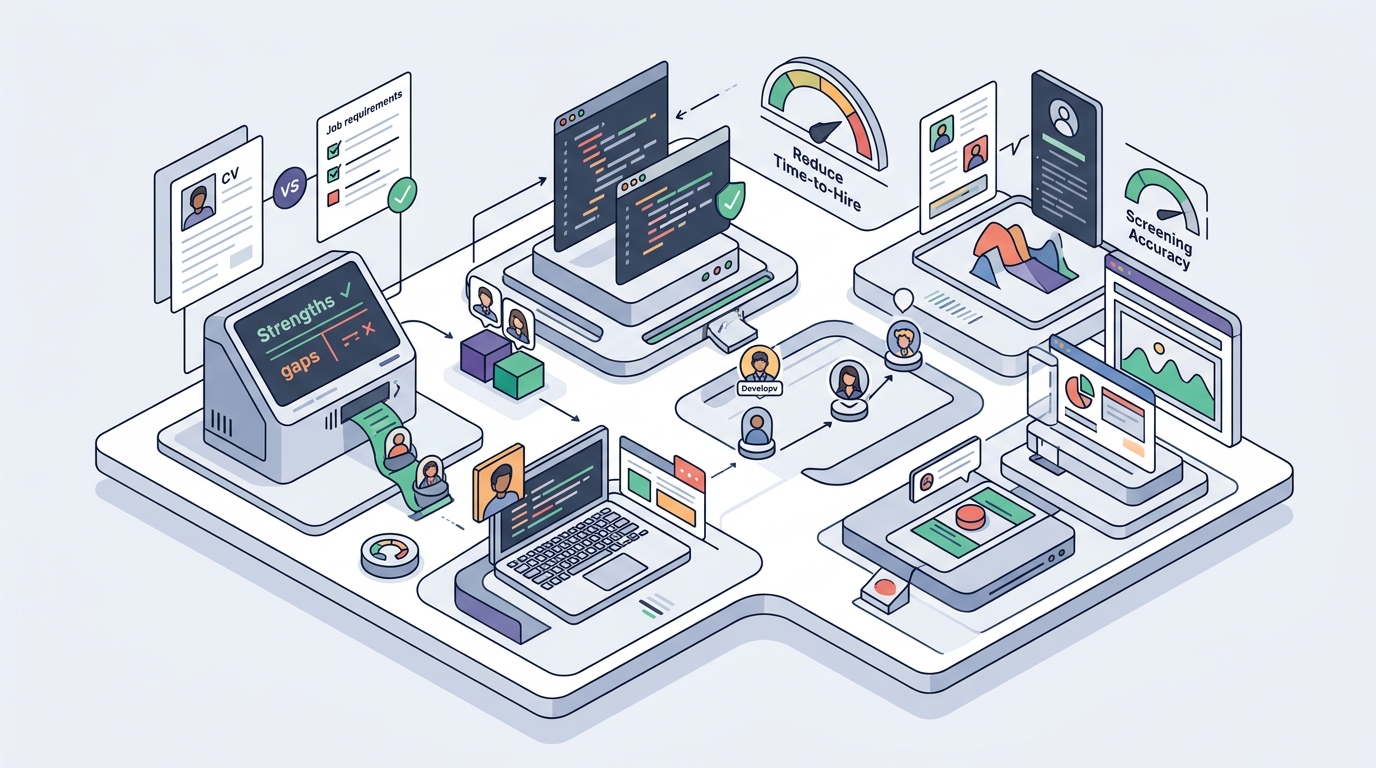
Recruiting firms use pre-employment assessment tools to verify candidate claims, evaluate technical skills, and predict cultural fit before scheduling interviews. These digital platforms reduce time-to-hire and improve screening accuracy. This guide covers the five primary categories of assessment software used by modern staffing agencies and startups. For additional details, review the Vaultio Hiring Infrastructure for.
Technical Skills Testing
Technical skills testing is the process of evaluating a candidate's ability to perform specific job-related tasks using practical exercises. For engineering and product roles, this is the most critical component of the screening pipeline. Traditional multiple-choice quizzes often fail to capture real-world coding ability. Modern platforms use automated code graders and live coding environments to assess syntax, logic, and problem-solving speed. For additional details, review the .
Automated Code Grading
Automated code grading is a method where software evaluates a candidate's code against a set of test cases. This approach provides objective data on whether a candidate can write functional code. It allows recruiters to filter out candidates who cannot meet basic technical requirements before a human interview. This saves significant time for both the agency and the client. For additional details, review the Customer Experience.
CV Claim Verification
CV claim verification is the practice of cross-referencing a candidate's resume against their actual performance in a test. Many candidates exaggerate their experience or skills. Assessment tools can generate role-specific questions based on the specific technologies listed in a CV. If a candidate claims expertise in a specific framework but fails to demonstrate it in the test, the system flags this discrepancy. This helps recruiters identify candidates who are honest about their skill levels. For additional details, review the Frequently Asked Questions.
Cognitive Ability Tests
Cognitive ability tests are standardized assessments designed to measure a candidate's general mental capabilities. These tests evaluate reasoning, memory, and processing speed. They are often used for entry-level roles or positions that require high adaptability. Unlike technical tests, cognitive tests are role-agnostic. They provide a baseline for how quickly a candidate can learn new information. For additional details, review the About.
Verbal and Numerical Reasoning
Verbal and numerical reasoning are two core components of cognitive testing. Verbal reasoning measures the ability to understand and interpret written information. Numerical reasoning measures the ability to work with data and numbers. These skills are essential for roles in finance, data analysis, and management. High scores in these areas often correlate with faster onboarding times.
Adaptability and Learning Agility
Personality Assessments
Personality assessments are psychological tools used to evaluate a candidate's behavioral tendencies and work style. These tests help recruiters understand how a candidate might fit into a team culture. They are not designed to measure intelligence or skills. Instead, they provide insights into communication styles, stress tolerance, and collaboration preferences.
Big Five Personality Traits
Cultural Fit vs. Cultural Add
Cultural fit is the degree to which a candidate's values align with the company's values. Cultural add is the concept that diverse perspectives strengthen a team. Modern recruiting firms are moving away from pure cultural fit. They now look for cultural add, where a candidate brings new ideas and approaches. Personality assessments can help identify candidates who will challenge the status quo in a positive way.
Job Simulations
Job simulations are assessments that mimic real-world tasks a candidate would perform on the job. These tests provide the most accurate prediction of on-the-job performance. They are particularly useful for roles that require specific software skills or process knowledge. Job simulations can range from simple document editing tasks to complex project management scenarios.
Work Sample Tests
Work sample tests are a type of job simulation where candidates perform actual job tasks. For example, a marketing candidate might write a blog post or create a social media campaign. A product manager candidate might write a product requirement document. These tests provide concrete evidence of a candidate's ability to do the job. They are highly valued by hiring managers because they show real output.
Scenario-Based Assessments
Scenario-based assessments are simulations that present candidates with realistic workplace problems. Candidates must choose the best course of action from a set of options. These tests evaluate decision-making, prioritization, and problem-solving skills. They are useful for evaluating soft skills that are hard to measure in other ways. For example, a scenario might involve a conflict with a stakeholder. The candidate's response reveals their communication and conflict resolution style.
Behavioral Evaluations
Behavioral evaluations are assessments that focus on a candidate's past actions and behaviors in specific situations. These evaluations often use structured interviews or written responses. They are based on the premise that past behavior is the best predictor of future behavior. Behavioral evaluations help recruiters understand how a candidate has handled challenges, conflicts, and successes in the past.
Structured Interview Questions
Structured interview questions are standardized questions asked to all candidates for a specific role. These questions are designed to elicit specific behavioral examples. For example, a question might ask, "Tell me about a time you had to meet a tight deadline." The candidate's response is then evaluated against a rubric. This reduces bias and ensures consistency in the evaluation process.
Integrity and Honesty Indicators
Integrity indicators are signals that suggest a candidate is honest and ethical. These can be derived from behavioral responses or from inconsistencies in a candidate's answers. Assessment tools can flag potential integrity issues for further review. It is important to note that these are flags, not definitive proof of dishonesty. Recruiters should use these signals as a starting point for deeper investigation, not as a final judgment.
Comparison of Assessment Types
| Assessment Type | Primary Purpose | Best For | Time to Complete |
|---|---|---|---|
| Technical Skills Testing | Verify technical proficiency | Engineering, Product, Data Roles | 30-60 minutes |
| Cognitive Ability Tests | Measure general mental capability | Entry-Level, Management Roles | 20-40 minutes |
| Personality Assessments | Evaluate work style and culture fit | All Roles | 15-30 minutes |
| Job Simulations | Predict on-the-job performance | Specialized, High-Responsibility Roles | 45-90 minutes |
| Behavioral Evaluations | Assess past behavior and integrity | Leadership, Client-Facing Roles | 30-45 minutes |
Key Takeaways
- Technical skills testing is essential for verifying the specific technical claims made in a candidate's CV.
- Cognitive ability tests provide a baseline for a candidate's learning agility and reasoning skills.
- Personality assessments help recruiters understand a candidate's work style and potential cultural add.
- Behavioral evaluations focus on past actions to predict future behavior and integrity.
- Combining multiple assessment types provides a more holistic view of a candidate's capabilities.
- Recruiting firms should use assessment data to prioritize interview time for the most promising candidates.
Frequently Asked Questions
What is the most important type of pre-employment assessment?
The most important type depends on the role. For technical roles, technical skills testing is usually the most critical. For leadership roles, behavioral evaluations and personality assessments may be more important. A balanced approach that combines multiple types of assessments is generally recommended.
How long do pre-employment assessments take?
Most pre-employment assessments take between 15 and 90 minutes to complete. Technical tests and job simulations tend to be longer. Personality and cognitive tests are usually shorter. It is important to communicate the expected time commitment to candidates in advance.
Do assessment tools replace interviews?
Are pre-employment assessments fair and unbiased?
Assessment tools are designed to be fair and unbiased, but no tool is perfect. It is important to use validated tools and to monitor outcomes for adverse impact. Recruiters should use assessment data as one input in the decision-making process, not as the sole determinant.