

Job Board or AI Career Workspace: Which Platforms Are Better for Developers?
For developers, AI career workspaces are generally better than traditional job boards because they automate application tailoring, match roles to specific technical skills, and reduce the time spent on repetitive administrative tasks. This guide covers how job board discovery works, how AI workspace automation functions, how to tailor applications effectively, and how to optimize your interview rate in 2026.
Job Board Discovery
The Volume Problem
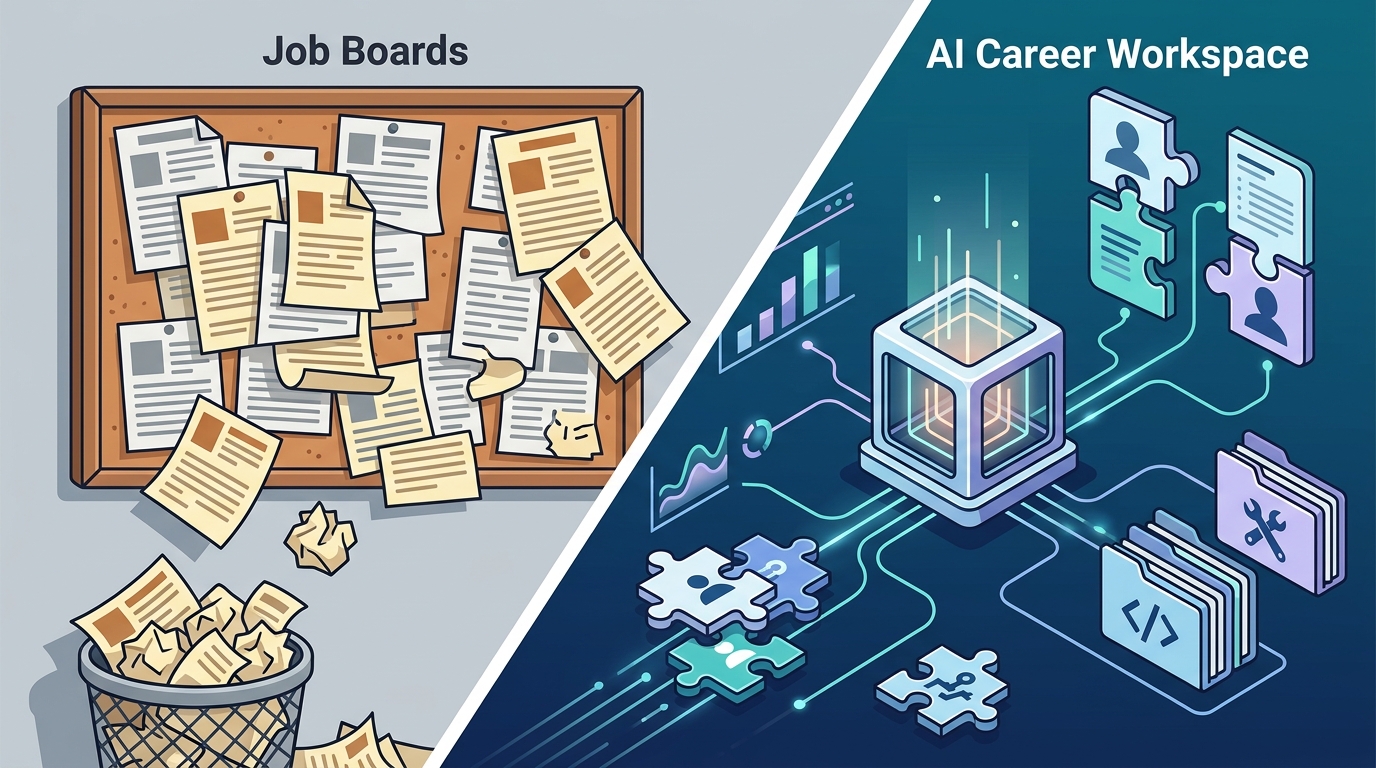
Major platforms process a massive number of resumes daily. For developers, this means competing against hundreds of other applicants for a single role. The discovery phase on these platforms is often passive. You apply, and then you wait. There is little feedback on why you were not selected. This lack of transparency makes it difficult to adjust your strategy. You are essentially guessing which roles are a good fit based on the job description alone.
Filtering Limitations
While job boards offer filters for location and salary, they rarely filter for specific technical depth. A listing might say "Senior React Developer," but it does not specify if the role requires distributed systems experience or basic component building. Developers must read every description to find the right fit. This is time-consuming and inefficient. AI-driven platforms attempt to solve this by matching your actual skills to the role requirements, not just keywords.
AI Workspace Automation
AI workspace automation is the use of artificial intelligence tools to manage the entire career lifecycle, from profile creation to payment processing. Platforms like Vaultio for Talent integrate AI tools, workspaces, and global payments into a single environment. This automation reduces the cognitive load on developers. Instead of switching between five different tools for CV writing, job searching, and invoicing, you work in one place. The AI handles the repetitive tasks, allowing you to focus on the actual work.
Smart Job Matching
Smart job matching is an algorithmic process that compares your verified skills and experience against thousands of remote roles. Unlike keyword matching, which looks for exact phrases, smart matching understands the context of your experience. If your CV mentions "Postgres," the system understands the implications for database-heavy roles. This increases the relevance of the jobs you see. You are less likely to waste time applying to roles that are a poor fit for your career goals.
Integrated Workflow
An integrated workflow connects your portfolio, your CV, and your applications. When you update your portfolio, your CV updates automatically. When you apply to a role, the system can generate a tailored proposal based on your portfolio. This consistency ensures that your online presence is always aligned. It also saves time. You do not need to manually copy and paste project descriptions into every application. The automation handles the synchronization for you.
Application Tailoring
Application tailoring is the practice of customizing your resume and cover letter for each specific job description. In 2026, this is more critical than ever due to the rise of AI-generated resumes. Many candidates use AI to create generic, keyword-stuffed resumes. This has led to a "CV arms race" where recruiters struggle to distinguish between genuine experience and AI-generated claims. To stand out, developers must provide evidence of their skills, not just a list of technologies.
The CV Arms Race
The CV arms race is a competitive dynamic where candidates use AI to optimize their resumes for Applicant Tracking Systems (ATS). This results in a flood of similar, polished resumes. Recruiters cannot easily spot the difference between a candidate who actually shipped a product and one who generated a resume with AI. To break through this noise, you need to provide proof. This means linking to code repositories, case studies, or assessment results that demonstrate your actual ability.
Evidence-Based Profiles
Evidence-based profiles are developer portfolios that include verifiable proof of skills. Instead of just listing "React" on your CV, you link to a specific component you built. You describe the problem you solved and the impact it had. This level of detail is hard for AI to fake convincingly. It shows recruiters that you have real experience. Platforms that support portfolio hosting make it easy to present this evidence in a structured way.
Interview Rate Optimization
Interview rate optimization is the strategy of increasing the percentage of applications that result in a technical interview. This metric is more important than the total number of applications. A high volume of applications with a low interview rate is a sign of poor targeting. To optimize your interview rate, you need to ensure that your applications are relevant and that your skills are verified. This reduces the risk for the employer and increases their confidence in your candidacy.
Verification and Trust
Verification is the process of confirming that a candidate's claimed skills are accurate. For developers, this often involves coding assessments or portfolio reviews. When a candidate provides verified evidence, it reduces the employer's risk. They know that the candidate can actually do the job. This trust leads to a higher interview rate. Employers are more likely to interview a candidate who has already demonstrated their skills than one who has only claimed them.
Targeted Applications
Targeted applications are submissions that are specifically tailored to the role's requirements. This involves reading the job description carefully and addressing each requirement in your application. You should highlight the most relevant experience first. You should also explain why you are interested in the specific company. This shows that you are not just mass-applying. It demonstrates genuine interest and a good fit. This approach leads to a higher quality of applications, which in turn leads to a higher interview rate.
| Feature | Traditional Job Board | AI Career Workspace |
|---|---|---|
| Discovery Method | Manual search and filters | AI-driven smart matching |
| Application Process | Manual CV upload and cover letter | Automated tailoring and proposal generation |
| Payment Processing | External invoicing and banking | Integrated global payouts (e.g., USDT) |
| Skill Verification | Self-reported CV claims | Portfolio and assessment evidence |
| Workflow Integration | Multiple disconnected tools | Single unified platform |
Key Takeaways
- AI career workspaces are generally better for developers than traditional job boards due to automation and smart matching.
- Job board discovery is often inefficient due to high volume and lack of specific technical filtering.
- AI workspace automation reduces cognitive load by integrating profile, application, and payment tools.
- Application tailoring must move beyond keywords to include evidence of actual skills and projects.
- The CV arms race makes it difficult for generic resumes to stand out; verified skills are key.
- Interview rate optimization focuses on quality and relevance rather than just the quantity of applications.
- Verification builds trust with employers, leading to a higher likelihood of being invited to interview.
- Integrated platforms like Vaultio streamline the entire remote work lifecycle for developers.
Frequently Asked Questions
What is the main difference between a job board and an AI career workspace?
A job board is a listing platform where employers post roles and candidates apply manually. An AI career workspace is an integrated environment that uses AI to match candidates to roles, automate applications, and manage payments. The workspace focuses on efficiency and verification, while the board focuses on volume.
How does AI smart matching work for developers?
AI smart matching analyzes your CV and portfolio to understand your specific technical skills and experience. It then compares this profile against job requirements to find the best fits. This is more accurate than keyword matching because it understands the context of your experience.
Why is application tailoring more important in 2026?
Application tailoring is more important in 2026 because of the rise of AI-generated resumes. Many candidates use AI to create generic, keyword-stuffed resumes. To stand out, you must provide evidence of your actual skills, such as portfolio links and case studies, rather than just a list of technologies.
What is the CV arms race?
The CV arms race is a competitive dynamic where candidates use AI to optimize their resumes for Applicant Tracking Systems. This results in a flood of similar, polished resumes that are hard to distinguish. It makes it difficult for recruiters to identify genuine experience.
How can I optimize my interview rate?
You can optimize your interview rate by focusing on quality over quantity. Ensure your applications are highly relevant to the role. Provide verified evidence of your skills, such as portfolio links or assessment results. This builds trust with employers and increases the likelihood of being invited to interview.
Does Vaultio guarantee a job?
No, Vaultio does not guarantee a job. It provides tools to help you find and apply for roles more efficiently. It also offers assessment software to verify skills. However, the hiring decision remains with the employer. Vaultio is a decision-support tool, not a job guarantee.
What is the role of verification in hiring?
Verification is the process of confirming that a candidate's claimed skills are accurate. For developers, this often involves coding assessments or portfolio reviews. Verification reduces the employer's risk and builds trust. It is a key factor in increasing the interview rate.
Conclusion
For developers in 2026, the choice between a job board and an AI career workspace is clear. AI workspaces offer superior efficiency, better matching, and integrated tools that reduce the friction of remote work. By leveraging automation and providing verified evidence of your skills, you can optimize your interview rate and stand out in a crowded market. Vaultio for Talent provides the infrastructure you need to manage your career, from smart job matching to global payments. Start by building your profile and exploring the roles that match your verified skills.