

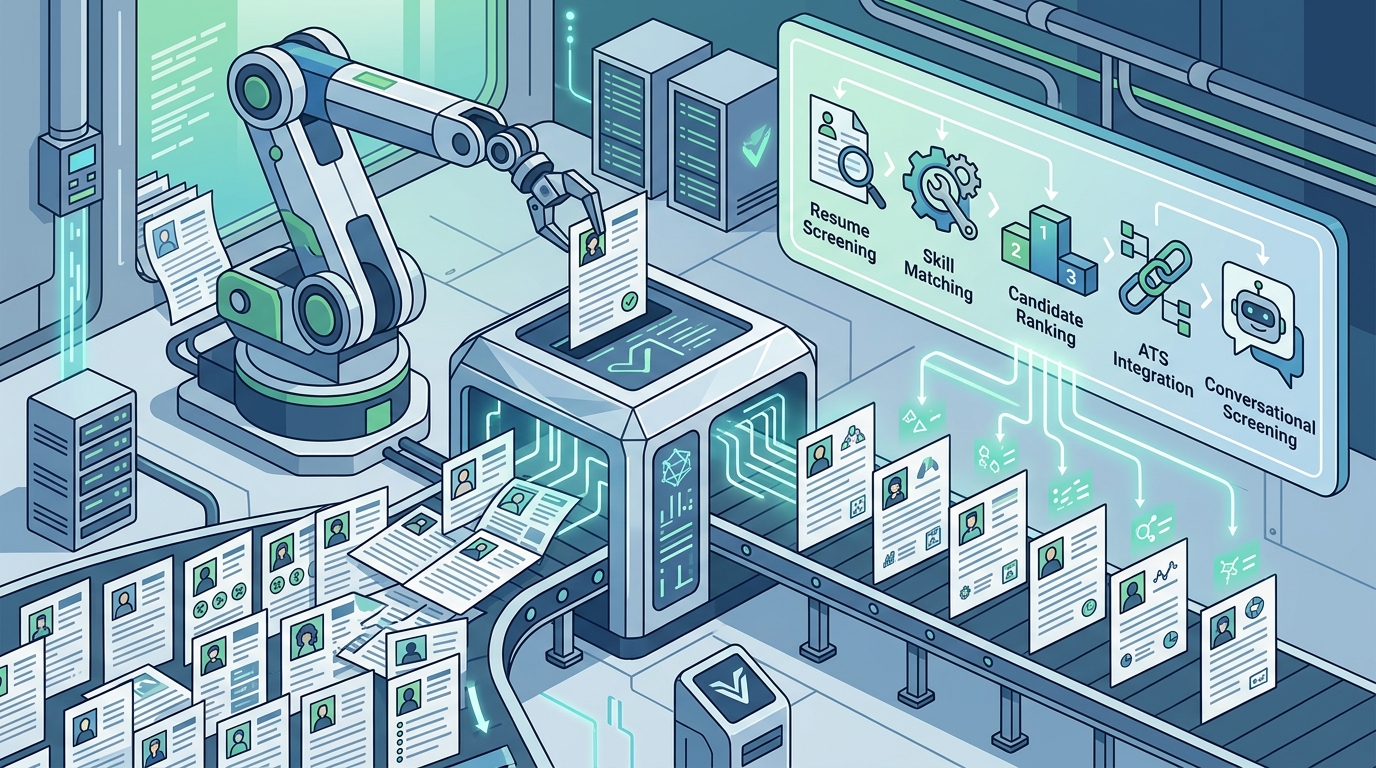
AI tools that shortlist candidates automatically use machine learning to parse resumes, match skills to job requirements, and rank applicants by fit. These systems filter large applicant pools to highlight the strongest matches for human review. This guide covers the five core capabilities of modern AI shortlisting: resume screening, skill matching, candidate ranking, ATS integration, and conversational screening. It also explains how assessment-first platforms like Vaultio add a layer of verified evidence to the process.
Resume Screening
Resume screening is the automated process of parsing and evaluating candidate resumes against specific job criteria. Traditional screening relies on recruiters reading documents manually, which is slow and inconsistent. AI tools accelerate this by extracting structured data from unstructured text. They identify key details such as years of experience, education, and specific technical skills. This allows hiring teams to filter out unqualified applicants quickly. However, resume screening alone has limitations. A polished resume does not always reflect actual ability. Candidates may use AI to generate tailored resumes that match keywords but lack substance. This creates a risk of false positives. To mitigate this, many platforms now pair resume parsing with verification steps. For example, Vaultio for companies uses AI to auto-score applicants against job descriptions. This provides an initial compatibility score before a human reviews the document. The goal is not to replace human judgment but to reduce the volume of noise. Recruiters can then focus their time on candidates who pass the initial automated filter. This approach improves efficiency without sacrificing the nuance of human evaluation.
Skill Matching
Skill matching is the alignment of a candidate's demonstrated competencies with the specific requirements of a role. Unlike simple keyword matching, advanced skill matching evaluates the depth and context of skills. It distinguishes between a candidate who has used a tool once and one who has mastered it in production. This is critical for technical roles where specific expertise is required. AI models analyze the candidate's profile, portfolio, and assessment results to build a skill profile. They compare this profile against the job description's required and preferred skills. The output is a detailed map of strengths and gaps. For instance, a role requiring React and PostgreSQL will be matched against the candidate's specific experience with those technologies. This goes beyond checking for the presence of a word. It assesses the level of proficiency. How Vaultio tests what you actually claimed on your CV explains how this works in practice. The platform generates assessments based on the specific skills claimed in the resume. If a candidate claims senior React experience, the assessment focuses on advanced React patterns. This ensures that the skill match is based on evidence, not just self-reporting. This level of granularity helps hiring managers make informed decisions about technical fit.
Candidate Ranking
Candidate ranking is the process of ordering applicants based on their overall fit for the role. AI algorithms assign scores to candidates based on multiple factors. These factors include resume quality, skill match, assessment performance, and other relevant data. The ranking provides a clear hierarchy of candidates. It helps hiring teams prioritize who to interview first. A well-designed ranking system considers both quantitative and qualitative signals. It balances hard skills with soft skills and cultural fit indicators. The output is a ranked list that reflects the probability of success. This does not mean the top candidate is guaranteed to be the best hire. It means they have the strongest evidence of fit based on the available data. Vaultio for companies provides auto-scored applicants, allowing teams to skim rather than sift through hundreds of resumes. The ranking is a decision-support tool. It highlights the top matches for human review. Recruiters can then adjust the ranking based on their own insights and interviews. This hybrid approach leverages AI for scale and human judgment for nuance. It ensures that the final shortlist is both efficient and thoughtful.
ATS Integration
ATS integration is the connection between AI shortlisting tools and Applicant Tracking Systems. Most companies use an ATS to manage their hiring pipeline. AI tools that integrate with ATSs can pull data directly from the system. This eliminates the need for manual data entry. It ensures that the AI has access to the most up-to-date candidate information. Integration also allows the AI to write back to the ATS. It can update candidate statuses, add notes, and trigger notifications. This creates a seamless workflow for hiring teams. The AI handles the initial screening and ranking, while the ATS manages the pipeline. This reduces friction and improves data consistency. For example, when a candidate is ranked highly by the AI, the ATS can automatically move them to the next stage. This saves time and reduces the risk of errors. Vaultio for companies is designed to work alongside existing ATSs. It does not require companies to switch their entire hiring process. Instead, it adds a layer of assessment and verification. This makes it easier to adopt. Companies can keep their current ATS and add AI-powered screening on top. This modular approach is attractive to organizations that are already invested in their existing tools.
Conversational Screening
Conversational screening is the use of AI chatbots to interact with candidates and gather information. These bots can ask questions, clarify details, and assess communication skills. They provide a more interactive experience than static forms. Candidates can respond in natural language, which allows for more nuanced evaluation. The AI analyzes the responses for clarity, tone, and relevance. This can help identify candidates who are strong communicators. It also allows the AI to dig deeper into specific experiences. For example, if a candidate mentions a project, the bot can ask for more details. This helps verify the depth of their involvement. Conversational screening is particularly useful for roles that require strong communication skills. It provides a low-stakes environment for candidates to demonstrate their abilities. However, it is important to use this tool ethically. Candidates should be informed that they are interacting with an AI. The bot should not be used to trick or manipulate candidates. It should be a helpful tool that makes the process smoother. Vaultio for talent offers AI tools that can assist candidates in preparing for such interactions. This ensures that candidates are ready for any part of the screening process. The goal is to create a fair and transparent experience for both sides.
Key Takeaways
- AI shortlisting tools automate resume screening, skill matching, and candidate ranking to improve efficiency.
- Resume screening alone is insufficient due to the rise of AI-generated resumes; verification is necessary.
- Skill matching evaluates the depth and context of competencies, not just keyword presence.
- Candidate ranking provides a hierarchy of applicants based on overall fit, serving as a decision-support tool.
- ATS integration ensures seamless data flow between AI tools and existing hiring pipelines.
- Conversational screening uses AI chatbots to assess communication skills and gather detailed information.
- Assessment-first platforms like Vaultio add a layer of verified evidence to the shortlisting process.
- Human judgment remains essential; AI tools should augment, not replace, human decision-making.
Frequently Asked Questions
What is the main benefit of using AI for candidate shortlisting?
The main benefit is efficiency. AI tools can process large volumes of applications quickly, highlighting the strongest matches for human review. This saves time and reduces the risk of missing qualified candidates.
Can AI tools replace human recruiters?
No, AI tools are designed to augment human recruiters, not replace them. They handle repetitive tasks like screening and ranking, allowing recruiters to focus on higher-value activities like interviewing and relationship building.
How does AI skill matching differ from keyword matching?
AI skill matching evaluates the depth and context of skills, while keyword matching only checks for the presence of specific words. This allows AI to distinguish between a candidate who has mastered a skill and one who has only used it briefly.
Is it ethical to use AI for screening?
Yes, provided it is used transparently and fairly. Candidates should be informed that AI is involved in the process. The AI should be used to reduce bias and improve consistency, not to replace human judgment.
How does Vaultio integrate with existing ATSs?
Vaultio is designed to work alongside existing ATSs. It adds a layer of assessment and verification without requiring companies to switch their entire hiring process. This makes it easy to adopt.
What is conversational screening?
Conversational screening is the use of AI chatbots to interact with candidates and gather information. It assesses communication skills and allows for more detailed evaluation of candidates' experiences.
Does AI guarantee a good hire?
How does Vaultio verify candidate skills?
Vaultio generates role-specific assessments based on the candidate's CV claims. This ensures that the skills are verified through evidence, not just self-reporting. The assessment results provide a detailed report on what the candidate actually demonstrated.