

AI tools can shortlist job candidates automatically by parsing resumes, matching skills to job requirements, and ranking applicants based on predefined criteria. This guide covers the five core automation layers: resume screening, skill matching, candidate ranking, ATS integration, and conversational screening. We explain how each layer works, where it fails, and how platforms like Vaultio fit into the modern hiring stack.
Resume Screening
Resume screening is the process of using AI to parse unstructured resume data and filter out applicants who do not meet basic job requirements. Traditional keyword matching is the oldest form of this automation. It scans for specific terms like "Python" or "Project Management" and flags resumes that contain them. However, this method is brittle. It fails when candidates use synonyms or when the resume format is non-standard.
The Limitation of Keyword Matching
Keyword-based screening creates a false sense of security. A candidate might list "JavaScript" instead of "JS" and be filtered out. Conversely, a candidate might list a skill they do not possess just to pass the filter. This is known as the "keyword arms race." Candidates optimize their resumes for the algorithm, not for the role. This leads to a pool of applicants who look qualified on paper but may lack the actual experience.
Contextual Parsing
Modern AI tools use natural language processing (NLP) to understand context. Instead of just looking for a word, the model analyzes the sentence structure. It distinguishes between "used Python for data analysis" and "used Python to build a web scraper." This contextual understanding allows for more accurate initial filtering. It reduces the noise in the applicant pool before a human ever sees the resume.
Skill Matching
Skill matching is the alignment of a candidate's demonstrated abilities with the specific technical and soft skills required for a role. Unlike resume screening, which looks at what is written, skill matching attempts to verify what is true. This is where the gap between "claimed skills" and "actual skills" becomes critical.
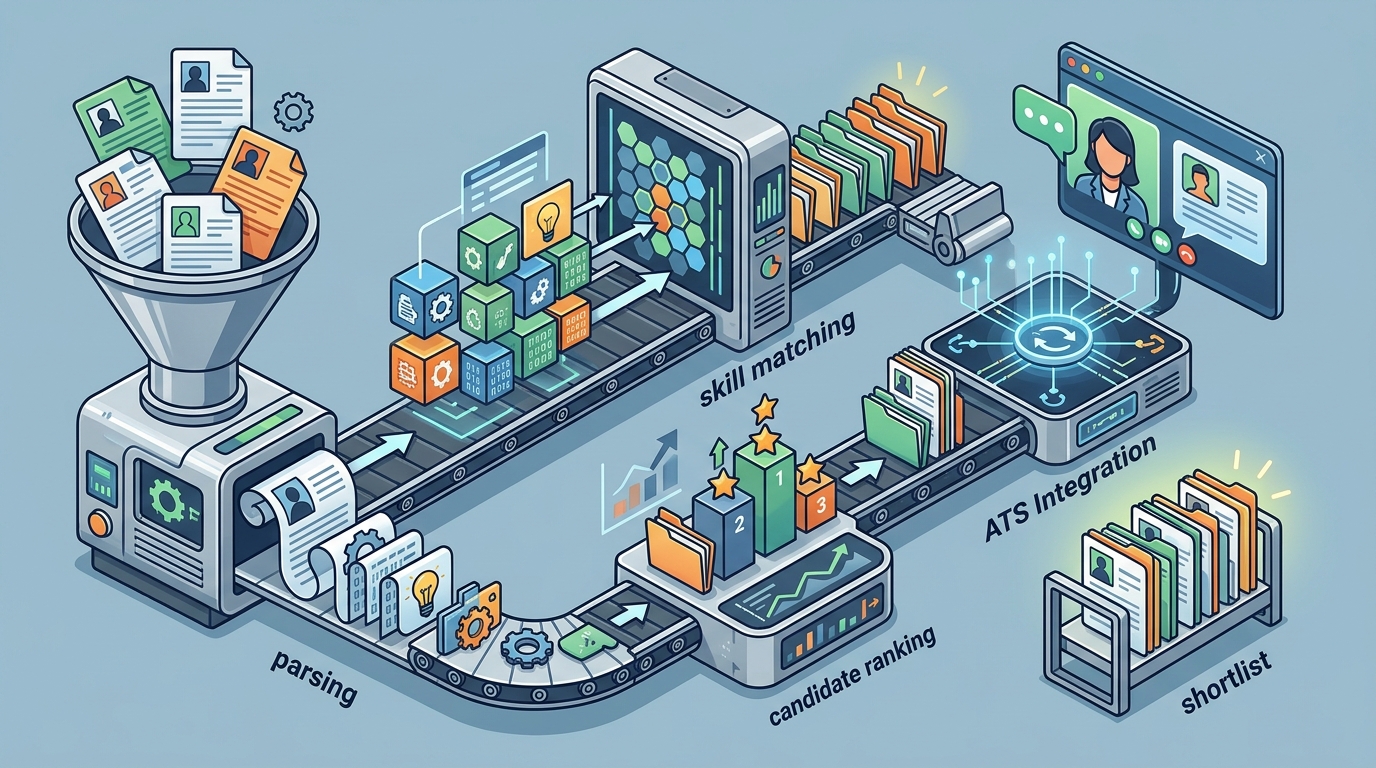
Static vs. Dynamic Assessment
Most ATS platforms rely on static skill matching. They compare the skills listed on the resume against the skills listed in the job description. This is a text-to-text comparison. It does not verify competence. A candidate can claim "Senior React" on their resume without having written a line of React code in five years. Static matching cannot detect this discrepancy.
Dynamic assessment, on the other hand, generates role-specific tests based on the job requirements. Platforms like Vaultio for Companies use this approach. They analyze the job description and the candidate's resume to create a unique assessment. This shifts the focus from "what do you claim" to "what can you do." It provides evidence of ability rather than just a list of keywords.
Candidate Ranking
Candidate ranking is the algorithmic ordering of applicants based on their fit for the role. The goal is to present the hiring manager with a shortlist of the top 5 to 10 candidates out of hundreds. The quality of this ranking depends entirely on the data inputs. If the inputs are just resume keywords, the ranking is superficial.
Scoring Models
AI ranking systems typically use weighted scoring models. Each skill or experience point is assigned a weight. A candidate's score is the sum of these weighted points. The challenge is setting the weights correctly. If "5 years experience" is weighted too heavily, a junior candidate with exceptional skills might be ranked lower than a senior candidate with average skills. This can lead to missed opportunities.
Advanced ranking systems incorporate assessment data. When a candidate completes a technical test, their score is updated based on their performance. This creates a more robust ranking. It combines the "paper" qualifications with the "practical" evidence. This hybrid approach is more reliable than keyword-only ranking.
ATS Integration
ATS integration is the connection between AI screening tools and the Applicant Tracking System (ATS) where resumes are stored. Most companies use an ATS like Greenhouse, Lever, or Workday. AI tools must integrate with these systems to access applicant data and push back shortlists.
API Connectivity
Integration usually happens via API. The AI tool pulls candidate data from the ATS, processes it, and sends back a ranked list. This requires robust data mapping. Fields like "years of experience" or "current role" must be mapped correctly between the two systems. Poor mapping leads to data loss or misinterpretation.
Some AI tools act as standalone platforms. They do not integrate with an existing ATS but replace it. This is a heavier lift for companies. It requires migrating all historical data and changing workflows. Other tools, like Vaultio, are designed to work alongside existing workflows. They focus on the assessment layer, which is often missing from standard ATS integrations.
Conversational Screening
Conversational screening is the use of chatbots or AI agents to conduct initial interviews with candidates. These bots ask predefined questions and evaluate the responses. The goal is to screen for communication skills, cultural fit, and basic technical knowledge without scheduling a human interview.
Pros and Cons
The main advantage is speed. A bot can interview 100 candidates in an hour. A human cannot. However, the quality of the interaction is limited. Bots struggle with follow-up questions. If a candidate gives a vague answer, a human interviewer would probe deeper. A bot might just move to the next question. This can lead to a shortlist of candidates who are good at answering bot questions but poor at handling real-world ambiguity.
Conversational screening is best used for high-volume, low-complexity roles. For senior technical roles, it is often insufficient. It should be a first-pass filter, not a final decision maker. The data from these conversations should feed into the overall candidate ranking model.
Key Takeaways
- Keyword-based resume screening is outdated and easily gamed by candidates.
- Static skill matching verifies claims, not competence.
- Dynamic assessment provides evidence of actual ability.
- Candidate ranking quality depends on the diversity of data inputs.
- ATS integration requires careful data mapping to avoid errors.
- Conversational screening is fast but lacks depth for complex roles.
- AI tools are decision-support, not decision-makers.
- Human judgment remains essential for final hiring decisions.
Frequently Asked Questions
Can AI tools replace human recruiters?
No. AI tools automate the screening and ranking process. They reduce the time recruiters spend on administrative tasks. However, they cannot replace the human judgment required for final hiring decisions. Recruiters still need to conduct interviews, assess cultural fit, and negotiate offers.
How do AI tools handle bias in screening?
AI tools can introduce bias if the training data is biased. For example, if historical hiring data favors certain demographics, the AI might learn to favor them in screening. Companies must audit their AI tools for bias. They should also use diverse data sets for training. Transparency in how the AI makes decisions is also crucial.
What is the difference between resume screening and skill assessment?
Resume screening analyzes what is written on the resume. Skill assessment tests what the candidate can actually do. Resume screening is passive; skill assessment is active. Skill assessment provides stronger evidence of competence.
Do AI tools work for non-technical roles?
Yes. AI tools can screen for soft skills, experience, and qualifications in non-technical roles. However, assessing soft skills is harder than assessing technical skills. AI tools often use natural language processing to analyze writing samples or interview transcripts to gauge communication skills.
How long does AI screening take?
AI screening is fast. It can process hundreds of resumes in minutes. The time required depends on the volume of applicants and the complexity of the screening criteria. For most roles, the initial screening is completed within hours of the application deadline.
Is it legal to use AI for hiring?
Yes, but with regulations. The EU AI Act and other local laws impose requirements on AI used in hiring. Companies must ensure their AI tools are transparent, non-discriminatory, and compliant with data protection laws. It is important to consult legal counsel when implementing AI in hiring.
Can candidates opt out of AI screening?
It depends on the company's policy. Some companies allow candidates to opt out of AI screening and request a human review. This is a good practice to build trust with candidates. It also helps with compliance in regions where AI use in hiring is restricted.
How does Vaultio fit into this workflow?
Vaultio focuses on the assessment layer. It generates role-specific tests to verify candidate skills. It integrates with existing workflows to provide evidence of ability. This complements resume screening and ranking by adding a practical verification step.
Conclusion
AI tools can significantly streamline the hiring process by automating resume screening, skill matching, candidate ranking, and conversational screening. However, they are not a silver bullet. They require careful implementation, monitoring, and human oversight. The key is to use AI for what it does best: processing large volumes of data quickly. Use human judgment for what it does best: making nuanced hiring decisions. Platforms like Vaultio offer a way to add a layer of practical verification to your hiring stack. By combining AI automation with human insight, you can build a more efficient and effective hiring process.