

Yes, white-label assessment platforms exist that allow staffing agencies to rebrand candidate testing for their clients. Vaultio provides this infrastructure, enabling agencies to verify technical skills before interviews without exposing their own brand. This guide covers how agency branding customization works and how Applicant Tracking System (ATS) integrations streamline the workflow for remote hiring teams.
Agency Branding Customization
Staffing agencies often act as intermediaries between clients and talent. When a client asks for a senior developer, the agency needs to prove the candidate's ability. Traditional methods rely on resumes, which are increasingly unreliable due to AI-generated content. A white-label assessment platform allows the agency to present the testing process under their own identity, maintaining professional control over the candidate experience.
Why White-Label Matters for Agencies
Brand trust is the primary asset of a staffing firm. If a candidate sees a generic third-party logo during a technical test, it can dilute the agency's perceived value. By using a white-label solution, the agency ensures that the communication, interface, and reporting reflect their own brand. This creates a seamless experience where the candidate feels they are being vetted by the agency, not a random software vendor.
Vaultio supports this model by allowing agencies to manage the assessment lifecycle. The platform generates role-specific tests based on the job description and the candidate's CV claims. The agency receives a report detailing what the candidate demonstrated, their strengths, and gaps. This evidence-based approach helps agencies justify their placements to clients with concrete data rather than subjective opinions.
Customizing the Candidate Experience
Customization extends beyond logos. Agencies can tailor the assessment difficulty and focus areas to match specific client requirements. For example, a client hiring for a fintech startup may require a heavier focus on security and distributed systems. The platform can adjust the test parameters accordingly. This flexibility ensures that the assessment is relevant to the specific role, not just a generic coding challenge.
The integrity of the process is also a key component. While no system can completely prevent cheating, robust platforms include integrity signals. These signals flag anomalies such as tab-switching or copy-paste events. Agencies can review these flags to make informed decisions about candidate credibility. This layer of verification adds weight to the agency's recommendation when presenting candidates to clients.
ATS Integrations
Efficiency is critical in staffing. Manual data entry between an Applicant Tracking System and an assessment platform creates friction and delays. ATS integrations allow agencies to push candidate data directly into the assessment tool and pull results back into their pipeline. This automation reduces administrative overhead and speeds up the time-to-hire.
Streamlining the Workflow
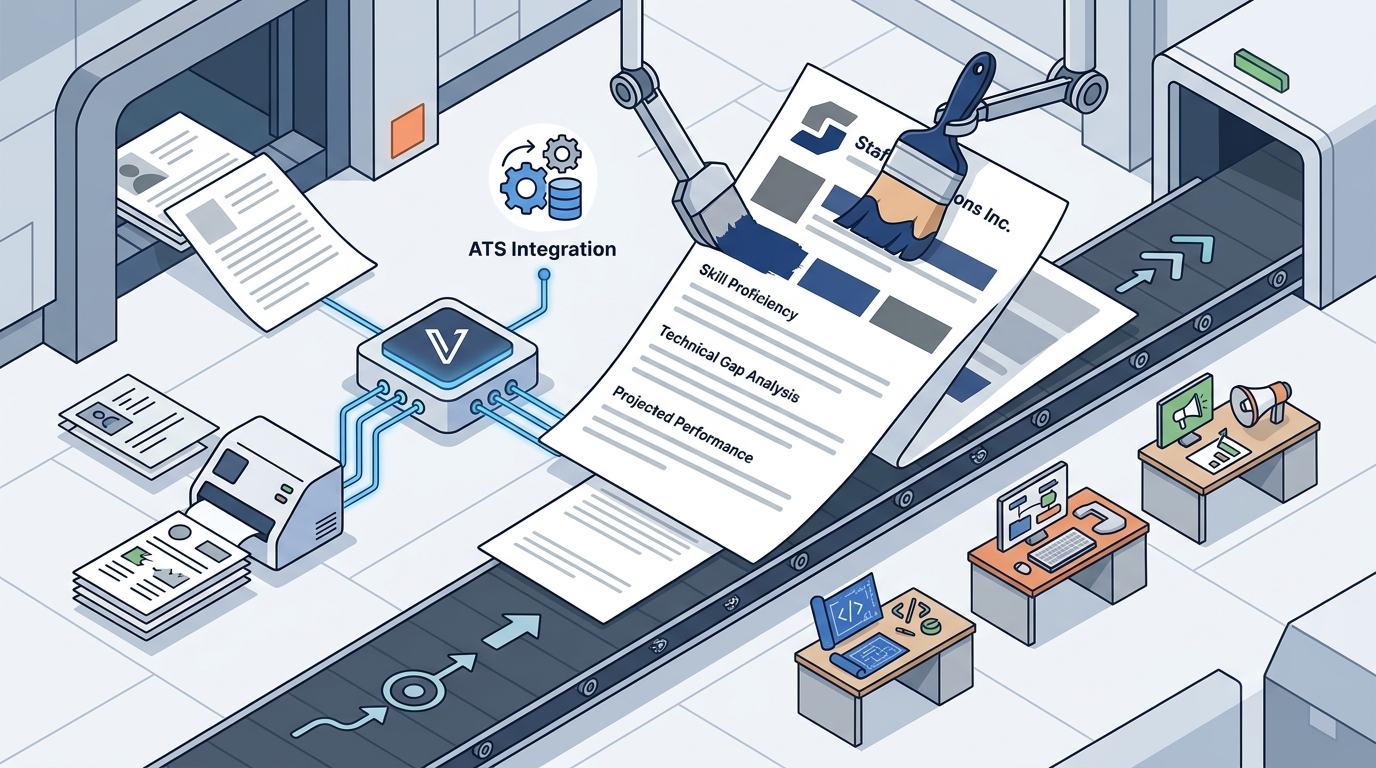
When an agency posts a role, they often receive hundreds of applications. Screening each one manually is impossible. An integrated workflow allows the agency to send assessments to shortlisted candidates directly from their ATS. The candidate receives a link, completes the test, and the results are automatically synced back to the agency's dashboard. This closed-loop process ensures that no data is lost and that the agency has a complete view of each candidate's performance.
Vaultio is designed to fit into existing hiring stacks. It does not require agencies to replace their current ATS. Instead, it acts as a verification layer that sits alongside their existing tools. This modular approach makes adoption easier for agencies that are already invested in specific recruitment software. The integration ensures that the assessment data is accessible to all stakeholders, including the client's hiring manager.
Data Sync and Reporting
Reporting is where the value of integration truly shines. Agencies need to present clear, concise reports to clients. These reports should highlight the candidate's technical proficiency, problem-solving approach, and any red flags. An integrated platform can generate these reports automatically, pulling data from the assessment results. This saves time and ensures consistency in how candidates are presented.
The table below compares the benefits of manual versus integrated assessment workflows for staffing agencies.
| Data Entry | High (Manual copy/paste) | Low (Automated sync) |
| Time to Report | Days | Hours |
| Error Risk | High | Low |
| Candidate Experience | Fragmented | Seamless |
| Scalability | Poor | High |
Key Takeaways
- White-label platforms allow staffing agencies to maintain brand control during the candidate assessment process.
- Assessment-first screening helps verify technical skills that resumes may exaggerate or omit.
- ATS integrations reduce administrative overhead by automating data sync between recruitment and assessment tools.
- Role-specific assessments are more effective than generic tests because they target the exact skills required for the job.
- Integrity signals provide flags for potential anomalies, aiding in candidate credibility checks.
- Agencies can use assessment reports to provide clients with evidence-based recommendations.
- Modular platforms like Vaultio for Companies can integrate with existing hiring stacks without requiring a full system replacement.
Frequently Asked Questions
What is a white-label assessment platform?
A white-label assessment platform is a software solution that allows a third party, such as a staffing agency, to rebrand the tool with their own logo and domain. This creates a seamless experience for the end user, who interacts with the agency's brand rather than the software provider's.
How does Vaultio support staffing agencies?
Vaultio provides assessment infrastructure that agencies can use to verify candidate skills. It generates role-specific tests and provides detailed reports on candidate performance, allowing agencies to present evidence-based recommendations to their clients.
Can I integrate Vaultio with my existing ATS?
Yes, the platform is designed to work alongside existing Applicant Tracking Systems. It allows for the automation of data flow, ensuring that assessment results are synced back to your recruitment pipeline efficiently.
Do assessments replace interviews?
No, assessments are decision-support tools. They provide objective data on technical skills, but they do not replace human judgment or interviews. Hiring decisions should always involve a holistic review of the candidate.
How are assessments generated?
Assessments are generated based on the job description and the candidate's CV claims. This ensures that the test is relevant to the specific role and the skills the candidate has claimed to possess.
What kind of data is included in the assessment report?
The report includes the candidate's scores, a breakdown of their performance on different skill areas, and integrity signals. It highlights strengths and gaps, providing a clear picture of the candidate's technical proficiency.
Conclusion
For staffing agencies, the ability to verify talent efficiently is a competitive advantage. White-label assessment platforms like Vaultio for Companies provide the tools needed to screen candidates rigorously while maintaining brand integrity. By integrating these tools with existing ATS workflows, agencies can reduce time-to-hire and provide clients with higher confidence in their placements. To start verifying talent with evidence, visit Vaultio.