

Job Board or AI Career Workspace: Which Platforms Are Better for Developers?
For developers in 2026, AI career workspaces are generally better than traditional job boards because they automate application tailoring and provide evidence-based screening. Traditional boards flood you with noise, while AI tools help you prove your skills. This guide covers job board discovery, AI workspace automation, application tailoring, and interview rate optimization.
Job Board Discovery
Job board discovery is the process of finding and filtering remote and local engineering roles. Traditional job boards like LinkedIn and Indeed remain the primary sources for volume. However, the sheer number of applications has created a signal-to-noise problem. Developers often spend more time searching than applying. The core issue is that job boards list roles but do not verify if the candidate can actually do the work. This leads to a crowded applicant pool where your resume competes with hundreds of others. For developers, this means that simply posting a profile is no longer enough to stand out. You need a strategy that moves beyond passive listing to active engagement.
The Volume Problem
Major platforms process thousands of resumes per minute. This volume is driven by AI-generated applications. When a job board receives 500 applications for a single role, recruiters rely on automated filters. These filters often prioritize keyword density over actual skill. As a result, a developer with strong practical skills but a generic resume may be filtered out. The discovery phase is where most developers lose momentum. They find the job, but they do not find a way to prove their value before the first screen.
Passive vs. Active Discovery
Passive discovery relies on the platform's algorithm to match you with jobs. Active discovery involves you targeting specific roles and tailoring your approach. In 2026, active discovery is more effective for developers. It allows you to control the narrative. Instead of waiting for a match, you select roles that align with your specific tech stack. This shifts the power dynamic from the employer to the candidate. You are no longer just a data point in a database; you are a targeted professional with a specific value proposition.
AI Workspace Automation
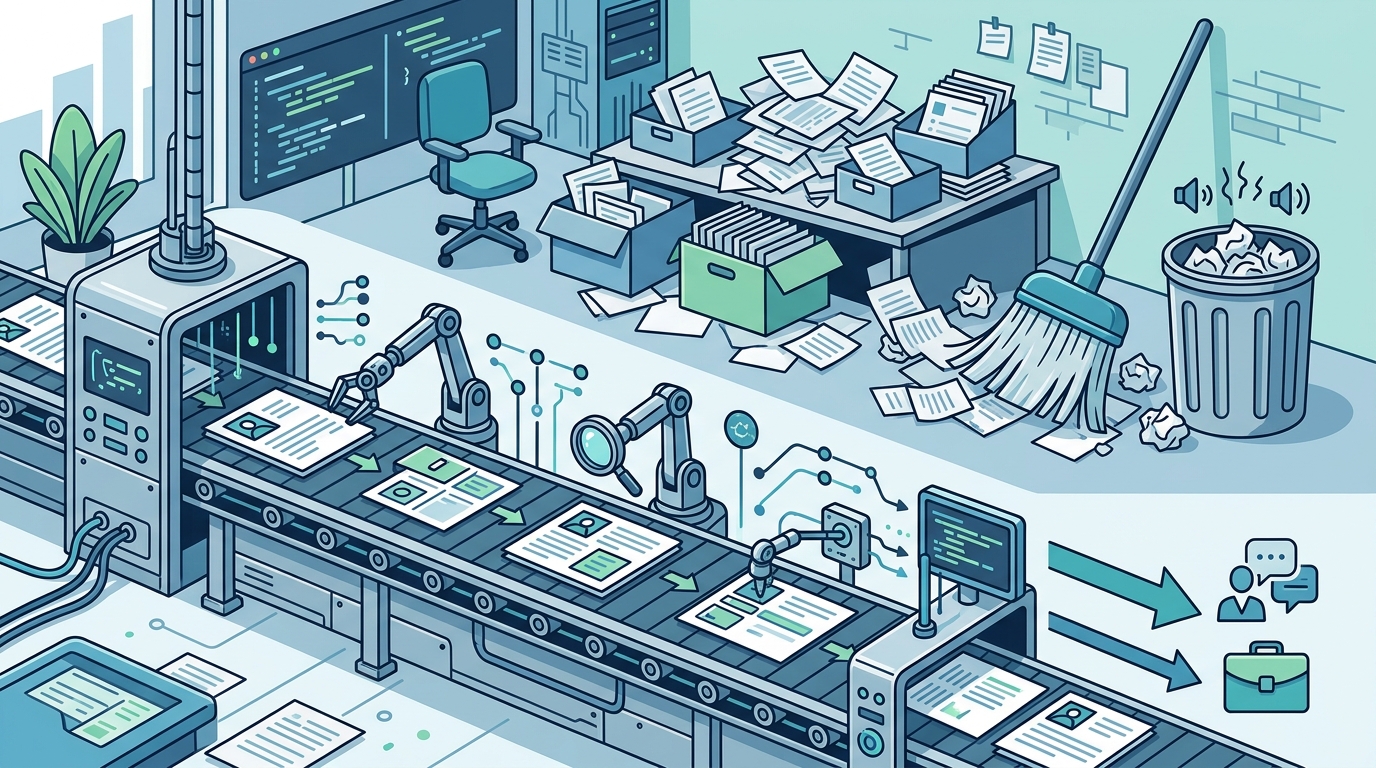
AI workspace automation is the use of integrated tools to manage your career workflow, including job matching, portfolio hosting, and communication. Unlike standalone job boards, an AI workspace centralizes your professional identity. It connects your skills, your work history, and your applications in one place. This reduces the friction of job hunting. You do not need to log into five different sites to update your profile. You update it once, and the AI handles the distribution and matching. This is particularly useful for developers who are busy shipping code and do not have time to manage multiple profiles.
Centralized Professional Identity
A centralized workspace allows you to build a single source of truth for your career. This includes your CV, your portfolio, and your assessment history. When you apply to a role, the platform can pull from this central hub. This ensures consistency across all your applications. It also allows you to showcase your work in a structured way. For developers, this means you can link to GitHub repositories or project case studies directly within your profile. The AI can then highlight the most relevant projects for each specific job description.
Automated Job Matching
Automated job matching uses AI to analyze your profile against thousands of open roles. It looks for patterns in your skills, experience, and preferences. This is different from keyword matching used by traditional ATS systems. AI matching understands context. It knows that a developer who has built a React app with a Node.js backend is a strong fit for a full-stack role, even if the keywords are slightly different. This reduces the time you spend searching for jobs. You receive a curated list of roles that are a high probability of fit. This allows you to focus your energy on the applications that matter most.
Application Tailoring
Application tailoring is the process of customizing your resume and cover letter for each specific job description. In the age of AI-generated resumes, generic applications are easily detected and ignored. Tailoring is no longer just about changing a few words; it is about demonstrating specific relevance. An AI workspace can help you tailor your application by analyzing the job description and highlighting the skills you possess. It can suggest how to frame your experience to match the employer's needs. This is not about lying; it is about presenting your truth in the most relevant way. For developers, this means emphasizing the specific technologies and methodologies you have used in past projects.
CV-Aware Test Generation
One of the most powerful aspects of modern AI workspaces is the ability to generate assessments based on your CV claims. If your CV says you are a senior Postgres developer, the platform can generate a Postgres-heavy test. This proves your skills in a way that a static resume cannot. It shifts the conversation from what you claim to what you can do. This is a critical differentiator in a crowded market. It shows the employer that you are confident in your abilities and willing to prove them. This level of tailoring is difficult to achieve manually for every application. AI makes it scalable and consistent.
Personalized Proposals
Personalized proposals are short, targeted messages that accompany your application. They explain why you are a good fit for the specific role. AI can help you draft these proposals by analyzing the job description and your profile. It can identify the key pain points the employer is trying to solve and frame your experience as the solution. This makes your application stand out from the crowd. It shows that you have read the job description carefully and that you understand the role's requirements. This level of personalization is rare in mass applications. It demonstrates a high level of professionalism and attention to detail.
Interview Rate Optimization
Interview rate optimization is the strategy of increasing the percentage of applications that result in a first interview. This is the ultimate metric of success for any job seeker. A high interview rate indicates that your applications are resonating with employers. It means that your profile, your resume, and your assessments are effectively communicating your value. To optimize your interview rate, you need to focus on quality over quantity. Applying to 100 jobs with generic applications is less effective than applying to 20 jobs with highly tailored, evidence-backed applications. This is where AI workspaces shine. They help you identify the roles where you have the highest probability of success.
Evidence-Backed Screening
Evidence-backed screening is the use of assessments to validate your skills before the interview. This is a key feature of platforms like Vaultio for Talent. It allows you to demonstrate your abilities in a structured, fair, and secure environment. The assessment is generated specifically for you and the role. This means that you are not competing against a static bank of questions that may have been leaked. You are solving novel problems that test your reasoning and practical skills. This gives you a significant advantage over candidates who rely solely on their resumes. It shows the employer that you can think on your feet and solve real-world problems.
Reducing Friction in the Process
Reducing friction is about making it easy for the employer to say yes. This includes providing clear, concise information about your skills and experience. It also includes making it easy for them to verify your claims. An AI workspace can streamline this process by providing a single link to your profile, your portfolio, and your assessment results. This reduces the cognitive load on the recruiter. They do not need to dig through multiple documents to understand your background. They can see everything they need in one place. This makes you a low-risk, high-reward candidate. It increases the likelihood that they will move you to the next stage.
Platform Comparison
| Feature | Traditional Job Board | AI Career Workspace |
|---|---|---|
| Application Volume | High, unfiltered | Curated, matched |
| Resume Screening | Keyword-based ATS | AI-driven, context-aware |
| Skill Verification | None or generic tests | Role-specific, CV-aware assessments |
| Portfolio Integration | External links only | Integrated, structured portfolio |
| Payment & Contracts | Separate tools | Built-in, global payouts |
| Interview Rate | Low, due to noise | Higher, due to evidence |
Key Takeaways
- AI career workspaces are superior to traditional job boards for developers in 2026 due to their ability to automate and tailor applications.
- Job board discovery is still necessary for volume, but it must be combined with active, targeted strategies to be effective.
- AI workspace automation centralizes your professional identity, reducing the friction of managing multiple profiles.
- Application tailoring is critical in the age of AI-generated resumes; generic applications are easily ignored.
- CV-aware test generation allows you to prove your skills in a way that a static resume cannot.
- Interview rate optimization focuses on quality over quantity, applying to fewer roles with higher probability of success.
- Evidence-backed screening using role-specific assessments gives you a significant advantage over other candidates.
- Reducing friction in the application process makes you a low-risk, high-reward candidate for employers.
Frequently Asked Questions
Are AI career workspaces better than job boards for developers?
How does AI workspace automation work?
It uses AI to match your profile with jobs, tailor your applications, and manage your portfolio. It centralizes your career data, so you do not have to update multiple profiles. It also provides insights into your strengths and gaps.
What is CV-aware test generation?
It is a feature where the assessment is generated based on the specific claims in your CV. If you claim to be a senior React developer, you get a React-heavy test. This proves your skills in a relevant and fair way.
How can I optimize my interview rate?
Focus on quality over quantity. Apply to fewer roles with highly tailored, evidence-backed applications. Use AI tools to identify the roles where you have the highest probability of success. Provide clear, concise information about your skills and experience.
Do AI workspaces replace human judgment?
No. AI workspaces provide decision-support information, not employment advice. They help you present your skills effectively, but the final hiring decision remains with the employer. They do not guarantee a job or remove bias.
Is it safe to use AI for my applications?
Yes, as long as you use it to present your truth in the most relevant way. Do not use AI to lie or exaggerate your experience. Use it to highlight your strengths and frame your experience in a way that matches the employer's needs.
What are the benefits of a centralized professional identity?
It ensures consistency across all your applications. It makes it easy for employers to see your full background in one place. It also allows you to showcase your work in a structured way, which is particularly useful for developers.
How does evidence-backed screening work?
It uses assessments to validate your skills before the interview. The assessment is generated specifically for you and the role. This means that you are solving novel problems that test your reasoning and practical skills. This gives you a significant advantage over candidates who rely solely on their resumes.
Conclusion
The choice between a job board and an AI career workspace is clear for developers in 2026. While job boards provide volume, AI workspaces provide the tools to cut through the noise. By leveraging automation, tailoring, and evidence-based screening, you can significantly improve your interview rate. Platforms like Vaultio for Talent offer a comprehensive suite of tools to help you succeed. They allow you to build a centralized professional identity, match with relevant roles, and prove your skills with role-specific assessments. This is the future of remote work for developers. It is time to move beyond passive listing and start actively proving your value. Start working remotely with Vaultio today and take control of your career.