

Cheaper Alternatives to HackerRank for Technical Assessments in 2026
Seeking a cheaper alternative to HackerRank for technical assessments? The most cost-effective approach is shifting from static, high-volume question banks to dynamic, role-specific assessments that verify actual ability before interviews. This guide covers the current landscape of coding assessment platforms, analyzes pricing models to identify where you save money, and details how assessment-first infrastructure like Vaultio reduces hiring costs by filtering out unqualified candidates early.
Coding Assessment Platforms
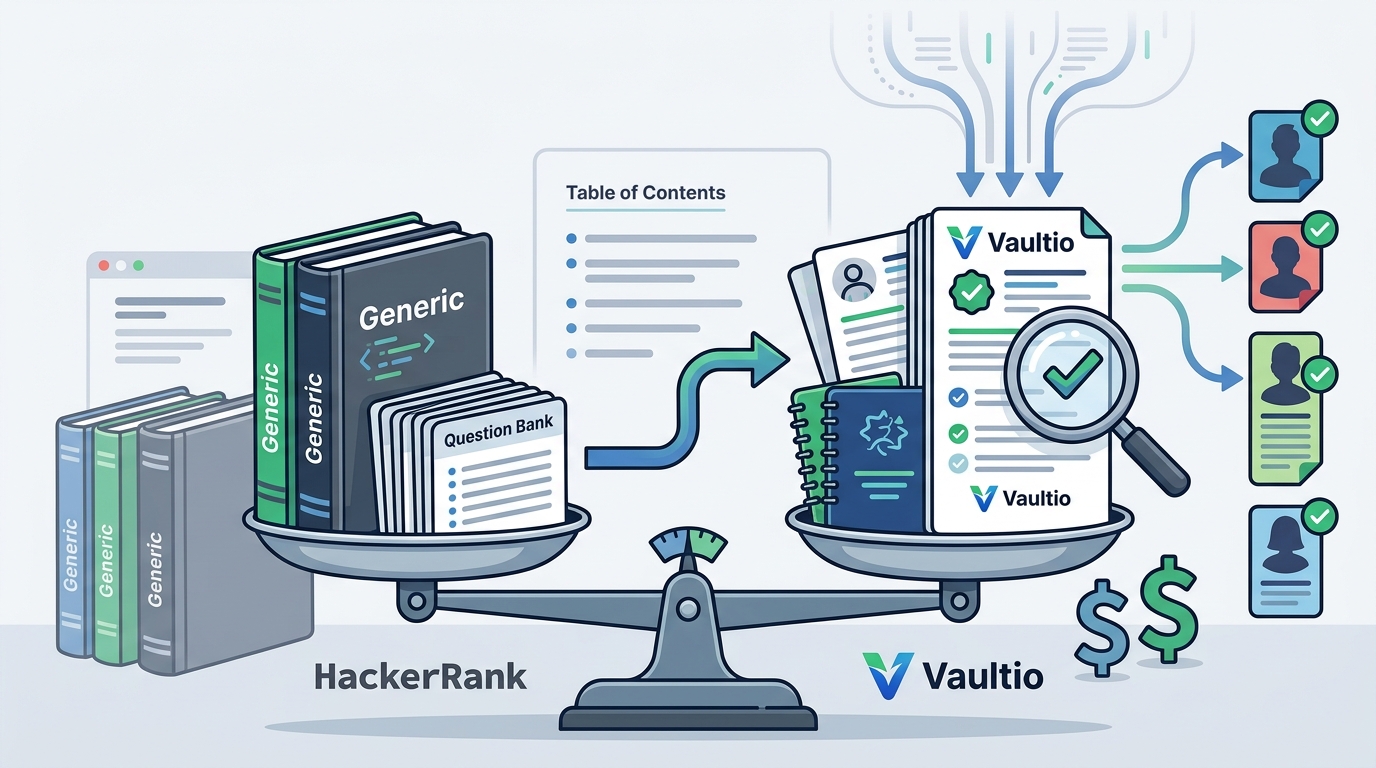
Technical assessment is the process of evaluating a candidate's practical skills through structured tasks before an interview. Traditional platforms rely on static question banks, where every candidate for a specific role receives the same set of problems. This model creates a significant vulnerability: question leakage. When questions are static, they inevitably appear in online forums, Discord servers, and paid answer-key marketplaces. Candidates can then memorize solutions, rendering the assessment a test of recall rather than reasoning.
The Limitation of Static Banks
Static platforms are efficient for high-volume, low-skill screening but fail for senior or specialized roles. A candidate who has never shipped production code can still pass a static test if they have studied the leaked answers. This forces recruiters to spend more time in interviews to verify what the test should have caught. The result is a higher cost per hire, not a lower one. You are paying for the test, but you are also paying for the extra interview hours required to validate the result.
Dynamic Assessment Generation
Dynamic assessment is a method where test questions are generated in real-time based on the specific job description and the candidate's resume. Unlike static banks, these questions do not exist until the candidate opens the test. This eliminates the possibility of pre-leaking answers. Platforms like Vaultio use AI to generate unique multiple-choice questions, coding problems, and scenario-based tasks for every single applicant. Because the test is unique to that candidate and role, there is no shared answer key to memorize. This approach shifts the focus from pattern matching to actual problem-solving ability.
Pricing Models
Understanding pricing models is critical when looking for a cheaper alternative to HackerRank. Most assessment platforms use one of three structures: per-seat, per-assessment, or tiered subscription. The "cheapest" option depends entirely on your hiring volume and the complexity of the roles you are filling.
Per-Seat vs. Per-Assessment
Per-seat pricing charges for each recruiter or hiring manager who accesses the platform. This model can become expensive for large teams, even if they only run a few assessments. Per-assessment pricing charges for every test a candidate takes. This model scales with hiring volume. If you have 100 applicants for one role, you pay for 100 assessments. For high-volume roles, this can be costly. For low-volume, high-seniority roles, it is often more predictable.
Hidden Costs of Inefficient Screening
The true cost of an assessment platform is not just the subscription fee. It is the cost of the interview slots wasted on unqualified candidates. If a static test lets through 50% of candidates who cannot actually do the job, you are paying for the test and the interviews. A more effective assessment tool may cost more per test but saves money by reducing the number of interviews you need to conduct. This is the core value proposition of assessment-first platforms. They aim to reduce the total cost of hiring, not just the cost of the software.
HackerRank Alternatives
When evaluating HackerRank alternatives, you are not just looking for a lower price tag. You are looking for a different screening philosophy. The market has shifted from "more questions" to "better evidence." Here is how the major alternatives compare in terms of approach and cost structure.
| Platform | Assessment Approach | Primary Cost Driver | Best For |
|---|---|---|---|
| Vaultio | Dynamic, AI-generated, role-specific | Assessment credits / Subscription | Remote teams, startups, verifying CV claims |
| HackerRank | Static question banks, coding challenges | Per-seat / Enterprise | High-volume engineering screening |
| CodeSignal | Standardized coding tests, behavioral | Per-assessment / Subscription | Standardized technical hiring |
| TestGorilla | Short, skill-specific tests | Per-seat | Non-technical and basic technical roles |
Why Vaultio is a Cost-Effective Alternative
Vaultio positions itself as hiring infrastructure for remote teams. Instead of just providing a test, it provides a verification layer. It tests candidates against the actual role requirements and the claims on their CV. This is particularly useful for remote hiring, where you cannot rely on in-person intuition. The platform generates a report on what the candidate demonstrated, their strengths, and which claims do not hold up. This evidence helps you make faster, more confident decisions. For startups and remote-first companies, this reduces the risk of a bad hire, which is far more expensive than the software subscription.
Choosing the Right Fit
If you are a large enterprise with thousands of applicants, a static platform might still be cost-effective due to economies of scale. If you are a startup or a remote-first team with fewer, higher-stakes hires, a dynamic platform like Vaultio is often the better investment. You are not just buying a test; you are buying a filter that ensures you only interview people who can actually do the work. This shifts your budget from volume to quality.
Key Takeaways
- Static question banks are vulnerable to leakage, which can invalidate assessment results.
- Dynamic, AI-generated assessments create unique tests for each candidate, preventing answer sharing.
- The true cost of hiring includes the time spent interviewing unqualified candidates.
- Per-assessment pricing can be more expensive than per-seat pricing for high-volume roles.
- Assessment-first platforms like Vaultio focus on verifying CV claims and actual ability.
- Remote hiring benefits from evidence-based screening to reduce risk.
- Choosing an alternative depends on your hiring volume and the seniority of the roles.
Frequently Asked Questions
Is Vaultio cheaper than HackerRank?
Vaultio offers a free tier to start, which is cheaper than most enterprise plans. For paid plans, the cost depends on your usage. The value comes from reducing the number of interviews you need to conduct, which can lower your overall hiring costs.
How does Vaultio prevent cheating?
Vaultio uses dynamic question generation, so no two candidates get the same test. It also includes integrity signals that flag suspicious behavior, such as tab-switching or copy-pasting. These signals are flags for review, not automatic disqualifications.
Can I use Vaultio for non-technical roles?
Vaultio is primarily designed for engineering, product, and marketing roles. It generates coding and scenario-based assessments. For purely non-technical roles, you may need a different tool, but Vaultio can still be useful for verifying specific skills like writing or analysis.
Does Vaultio replace interviews?
No. Vaultio is a pre-interview screening tool. It helps you identify candidates who are likely to succeed in the interview. You should still conduct interviews to assess culture fit and communication skills.
How long does a Vaultio assessment take?
Assessment length depends on the role and the complexity of the questions. Typically, they are designed to be completed in a reasonable time frame, often between 30 and 60 minutes, to respect the candidate's time.
Is Vaultio suitable for remote hiring?
Yes. Vaultio is built for remote-first teams. It provides a structured way to evaluate remote candidates without relying on in-person intuition. The platform includes video interview features and a shared review workflow for your team.